Every piece of steel we send to a site has to be attached to something, and there are exactly two ways to do it: bolt it or weld it. The industry settled the general argument a long time ago, and the answer is both, in a specific pattern. Weld in the shop, bolt in the field. Nearly every commercial steel frame going up in Metro Vancouver right now follows that rule, and the reasons behind it decide real money and real days on your schedule.
We fabricate structural steel in Burnaby and detail the connections on every job we bid, so this question crosses our desk on every single project. Here is how the choice actually gets made.
Why weld in the shop and bolt in the field
Think about where each method is easy. In our shop, a welder works indoors on a piece positioned at a comfortable height, often rotated so the weld runs flat, with power, gas, grinding, and inspection all within reach. Under those conditions welding is fast, consistent, and cheap to verify. So the complicated parts of every connection, the clip angles, the end plates, the stiffeners, the welded seats, go onto the members in the shop under our CWB certification to CSA W47.1 through the CWB Group.
Now put that same weld thirty feet up on an open frame in a November rainstorm in Coquitlam. The welder needs access equipment, the joint needs shelter and possibly preheat, a fire watch has to stand by, and the inspector has to come to the weld instead of the weld coming to the inspector. Nothing about it is impossible. Everything about it is slower and more expensive than it was on the shop floor.
Bolting reverses the picture. Holes are drilled in the shop where drilling is easy, and the field crew just has to line them up and fill them. That is why the standard commercial connection is a shop-welded fitting on one member and a field-bolted interface between members.
Where bolting wins on site
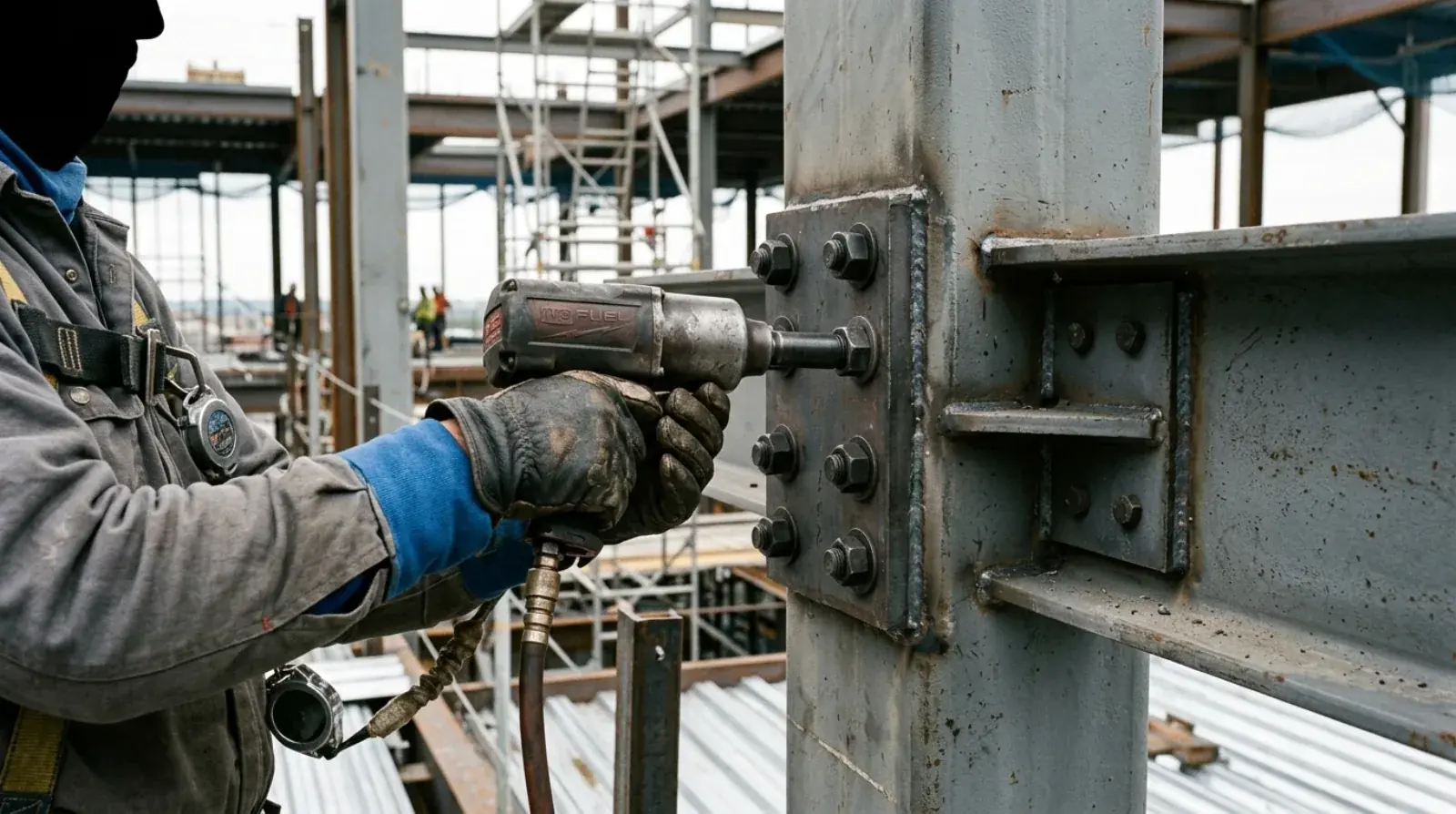
Speed is the obvious win. An erection crew lands a beam, drives a couple of drift pins to align the holes, installs the bolts, and the crane is free for the next pick within minutes. Multiply that across the hundreds of connections in a mid-size commercial frame and the difference against field welding is measured in weeks.
Weather is the quieter win, and in this region it matters just as much. Metro Vancouver hands a steel erector rain from October to April, and bolting works through all of it. A bolted connection made in the rain is exactly as good as one made in July. Field welding in the same conditions needs hoarding and heat, or it waits.
The third win is certainty. A bolted connection is either complete or it visibly is not: the bolts are in, the plies are tight, anyone can look. That makes quality easy to verify at pace, keeps inspectors moving, and takes one category of surprise out of the erection schedule. High-strength structural bolts themselves are manufactured to recognized ASTM standards, so the components arriving in the keg are a known quantity before the crew ever touches them.
Snug-tight and pretensioned, without the jargon
Bolted connections come in two levels of tightness, and the difference confuses people outside the trade more than it should.
Snug-tight is the ordinary case. The crew tightens the bolts until the connected plates are pulled into firm contact, about the full effort of a worker on a spud wrench. Nobody measures bolt tension, because the design does not need any particular tension, just solid bearing between the parts. Most beam-to-column shear connections in an ordinary building are snug-tight, and that simplicity is part of why bolting is fast.
Pretensioned connections take the same bolts further. Using a controlled tightening method, the crew stretches each bolt to a defined minimum tension, turning it into a clamp. The clamping force lets the joint resist slipping under load reversal, vibration, and earthquake demand, which is why pretensioning shows up in braced frames and other seismic elements common on BC projects. It costs more time per bolt and adds verification steps, so engineers specify it where the behaviour is needed and leave the rest of the building snug-tight. We cover how connection choices tie into earthquake design on our page about structural connections and seismic performance.
When field welding is the right call
Field welding never disappeared; it moved to the situations that justify it.
Some moment connections are detailed as field-welded because the engineer wants a continuous joint at that location, full stop. Retrofit and renovation work is another regular case: when we tie new steel into an existing Vancouver building, the existing member may be somewhere slightly different from where the drawings promised, and a welded connection can absorb that reality where a pre-drilled hole pattern cannot. Drilling into an existing loaded member is sometimes off the table entirely, which leaves welding as the connection of choice. And on exposed architectural steel, the design sometimes wants clean joined surfaces with no bolt heads in view.
What field welding always brings with it is a package of obligations: welders certified for the work, procedures qualified for position and conditions, shelter when the weather demands it, fire watch, and access equipment that lets the welder do proper work rather than reach-and-hope work. Priced honestly from the start, none of that is a problem. Discovered mid-erection, all of it is.
Inspection is not the same for both
The last difference lands on the schedule, and general contractors feel it most.
Bolted connections inspect quickly. The inspector confirms the right bolts went in, the plies are in contact, and the installation is complete, with additional checks on the tightening method where pretensioning was specified. It is largely visual, it happens at walking pace, and it rarely holds anything up.
Field welds inspect slowly. Every structural field weld gets visual inspection, and the engineer’s specification typically adds nondestructive testing on the joints that matter most. That testing is done by qualified inspectors, on site, at height, weld by weld, and the results have to close out before the work above can be counted on. On a job with many field welds, inspection becomes its own line in the erection sequence.
None of this makes one method good and the other bad. It makes them tools with different costs in different places, and the drawings should put each one where it earns its keep. If you are pricing a commercial steel package anywhere in Metro Vancouver and want the connections detailed for the way the building will actually be erected, send us the drawings and we will walk through it with you.