Metro Vancouver gets roughly 1,200mm of rain a year. Most of it lands between October and March, which means exterior steel sits wet for months at a stretch. The finish you put on that steel determines whether it still looks good in five years or becomes a maintenance headache that your strata council argues about every spring.
We fabricate and finish steel out of our Burnaby shop, and the finish conversation comes up on almost every exterior project. Homeowners want to know what holds up. Architects want to specify correctly. Contractors want to avoid callbacks. Here’s what we’ve learned from building and maintaining metalwork across Metro Vancouver since the shop opened.
Powder coating: the workhorse finish
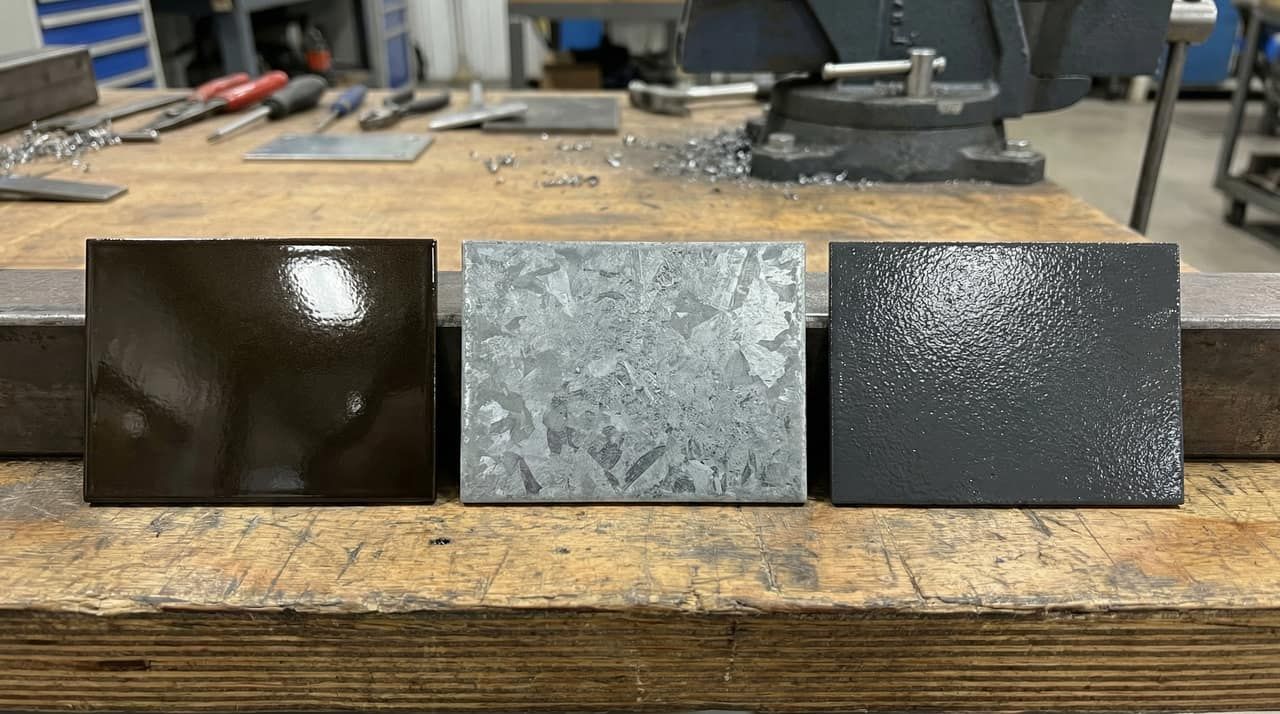
Powder coating is an electrostatically applied dry powder — usually polyester or polyester-TGIC — that gets baked onto the steel at around 200 degrees Celsius. The result is a hard, uniform film that’s thicker and more impact-resistant than wet paint. Standard thickness runs 60–80 microns (2–3 mils), though we spec thicker builds on high-traffic commercial work.
Cost: $8–$15 per linear foot on railing and gate work, depending on profile complexity. Larger structural pieces are priced by weight or surface area — a typical canopy frame might run $3–$6 per square foot of coverage.
Lifespan: 15–25 years on exterior steel in Metro Vancouver. That range is wide because exposure varies enormously. A powder-coated gate under a covered porch in East Vancouver will outlast the same finish on an exposed south-facing deck rail in West Van by a decade.
Colour options: Hundreds of RAL colours, plus metallic, textured, and custom-match options. Matte black (RAL 9005) accounts for about 60% of what we spray. Architects on North Shore custom builds tend toward dark bronze, graphite, or satin charcoal.
The process matters as much as the powder. Steel needs to be sandblasted to SA 2.5 (near-white metal) before coating. Skip that step or blast to a lower standard, and the powder loses adhesion within a few years. We’ve stripped and re-coated railings from other shops where the original fabricator sprayed over mill scale — the coating was peeling in sheets after two Vancouver winters.
Wet paint: cheaper up front, shorter clock
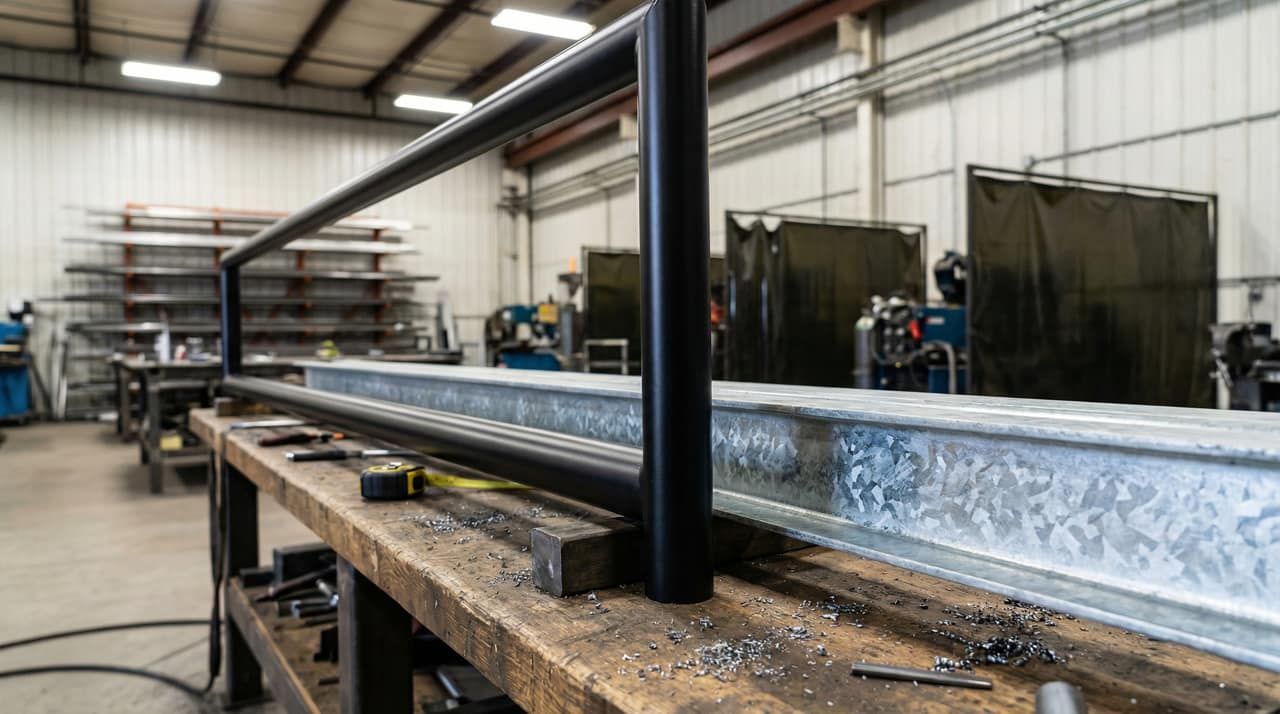
Wet paint — spray-applied or brush-applied — still has a place, but it’s a different tool for different situations. Two-part epoxy primers with polyurethane topcoats are the commercial standard. Single-component alkyd or acrylic paints are common on residential touch-ups and lower-budget work.
Cost: $4–$10 per linear foot for a proper two-coat system (primer plus topcoat). Cheaper than powder coating on a per-foot basis, but the math changes when you factor in recoating.
Lifespan: 5–10 years on exterior steel in our climate before you’re looking at touch-ups or a full recoat. High-performance marine-grade paint systems can stretch to 12–15 years, but they cost nearly as much as powder coating and require more surface prep discipline.
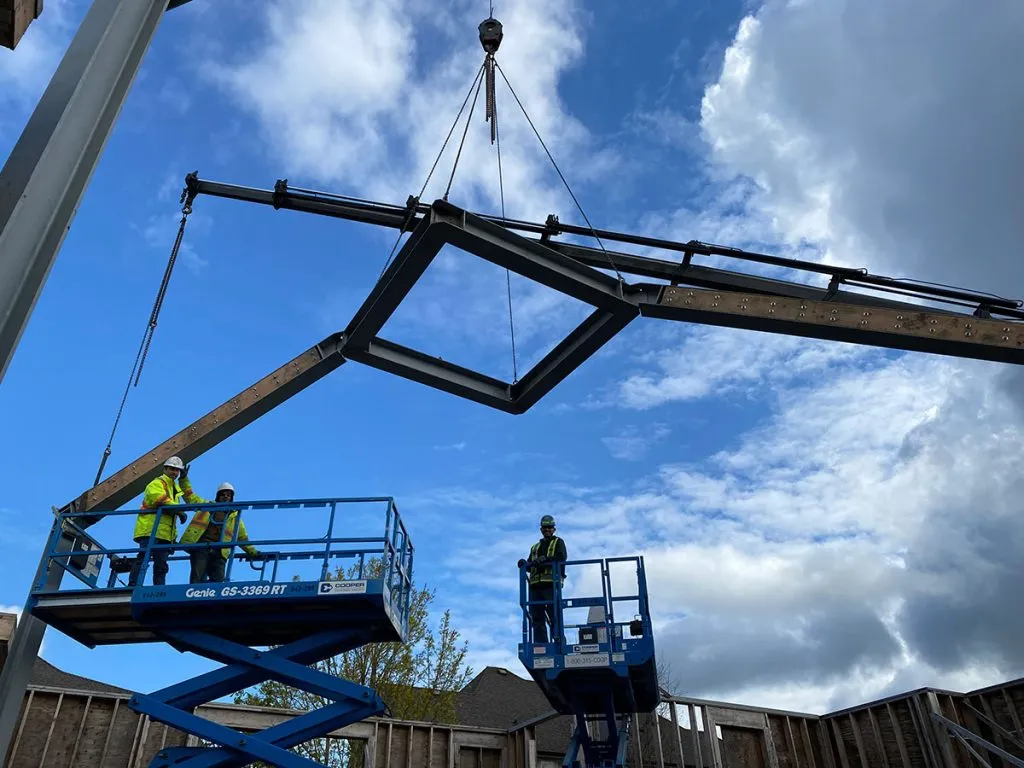
When it makes sense: Interior decorative steel where you want a specific sheen or hand-applied finish. Touch-up work on existing installations. Field-applied coatings on pieces too large to fit in a powder coat oven — we’ve spray-painted structural steel canopy frames on site when the assembled dimensions exceeded what the coating shop could handle. And on projects where the budget is tight and the client understands they’ll need maintenance in 5–7 years.
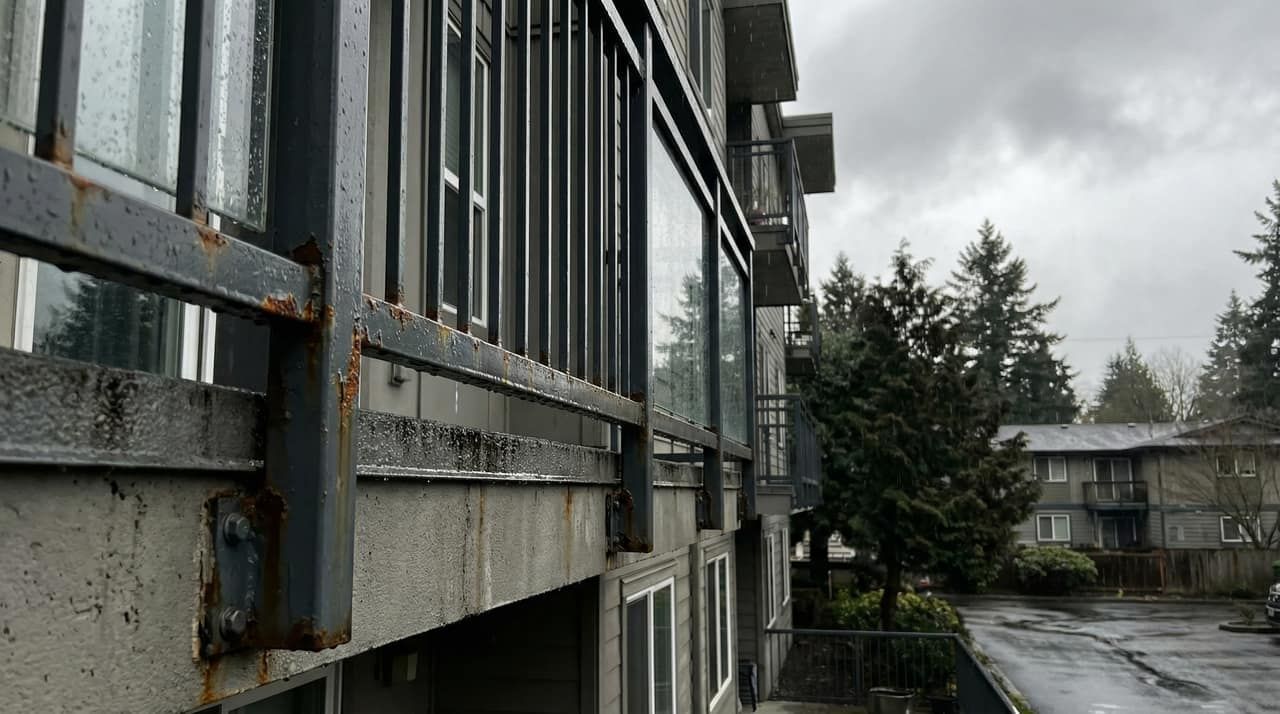
The failure mode with wet paint is predictable. It starts at edges, weld joints, and any spot where moisture can wick under the film. On a Coquitlam townhouse complex we were called in to repair, the original railings had been brush-painted with a single coat of rust-inhibiting enamel. Within 18 months, every weld joint was bleeding rust.
Hot-dip galvanizing: the heavy-duty option
Hot-dip galvanizing submerges the entire steel piece in a bath of molten zinc at about 450 degrees Celsius. The zinc bonds metallurgically with the steel surface, creating a layered alloy coating that’s typically 80–100 microns thick. It’s not a surface coating sitting on top of the steel — it’s fused into it.
Cost: $12–$25 per linear foot on railing and gate work. Structural steel is usually priced by weight: roughly $0.15–$0.30 per pound for standard shapes, more for complex assemblies with tight drainage requirements.
Lifespan: 20–30 years in Metro Vancouver’s environment before the zinc layer is consumed. The actual rate depends on atmospheric corrosivity — the ASTM C5 classification (very high, coastal industrial) applies to some waterfront areas, while most of Burnaby and the Tri-Cities sit in C3 to C4 range.
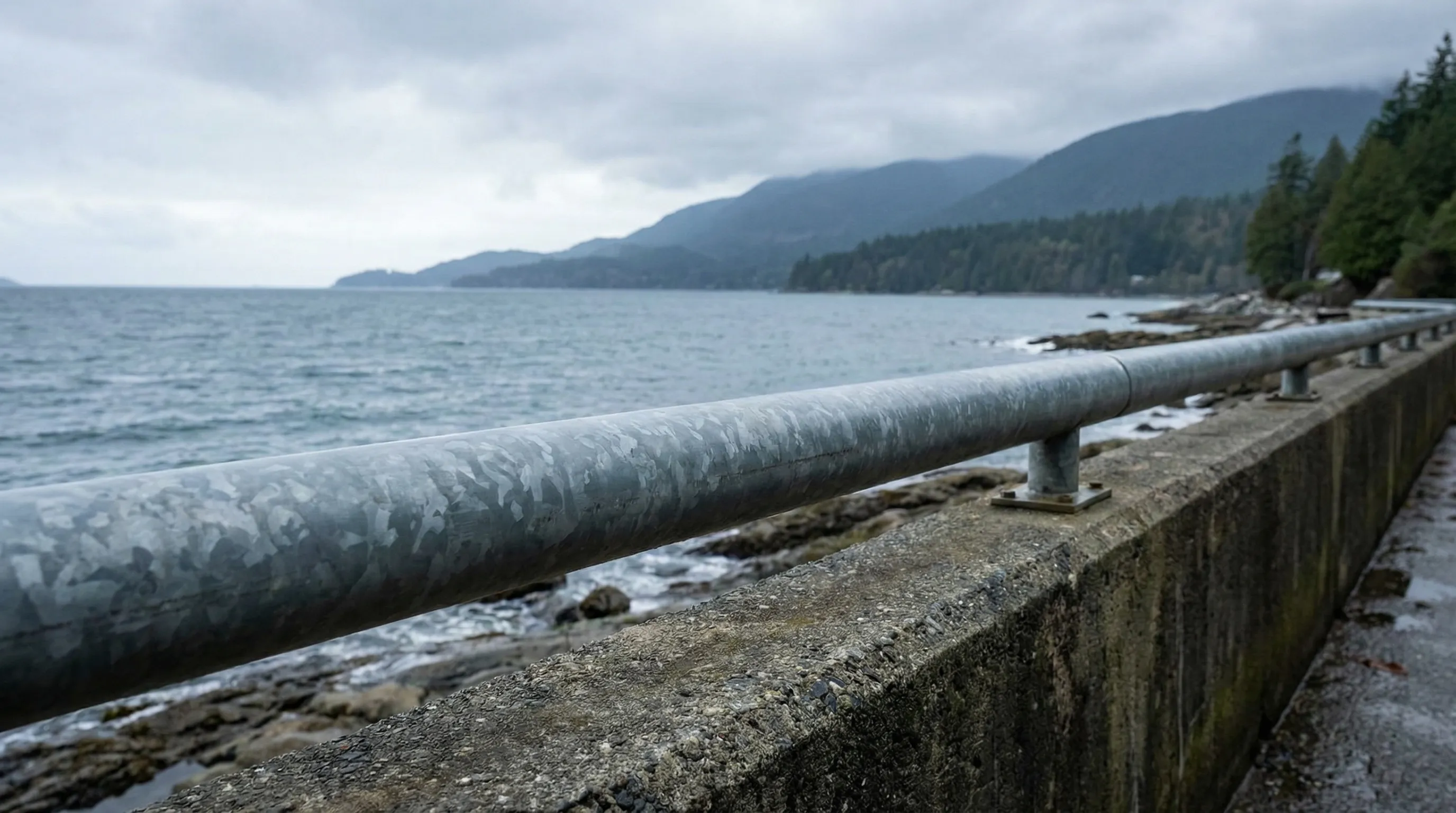
Appearance: Galvanized steel has a distinctive crystalline zinc pattern (called spangle) that weathers to a matte grey over 1–2 years. Some architects spec it as-is for an industrial aesthetic. Others want it coated — which brings us to the duplex system.
The zinc coating is sacrificial. If the surface gets scratched or cut, the surrounding zinc corrodes preferentially to protect the exposed steel. That self-healing property is why galvanizing outperforms paint and powder coating at damage points. A powder-coated railing that gets chipped exposes bare steel to moisture. A galvanized railing that gets chipped exposes zinc — and the zinc keeps protecting.
We galvanize all exterior structural steel and most exterior misc. metals. On a recent commercial canopy project in New Westminster, the architect initially spec’d powder coat only. We recommended galvanizing underneath, and the spec got updated after we showed them what ungalvanized steel looks like after five years of direct rain exposure on a nearby building.
The duplex system: galvanize plus powder coat
This is the premium approach, and for exterior steel in Vancouver’s climate, it’s the one we recommend most often. Galvanize first for corrosion protection, then powder coat over top for colour and UV resistance.
Cost: $20–$40 per linear foot when you combine galvanizing ($12–$25/ft) and powder coating ($8–$15/ft). On a 40-foot deck railing, that’s an additional $500–$1,000 over powder coat alone.
Lifespan: 30–50 years. The galvanizing and powder coating protect each other synergistically — the powder coat shields the zinc from atmospheric consumption, while the zinc prevents under-film corrosion if the powder coat gets damaged. Industry data from the American Galvanizers Association shows the duplex system lasts 1.5 to 2.3 times longer than the sum of each system’s individual lifespan.
There’s a preparation step that matters here. Fresh galvanized surfaces are too smooth and chemically reactive for powder to bond well. The galvanized steel needs either a light sweep blast, a chromate-free pretreatment, or aging before coating. We coordinate with our galvanizer and powder coater to get the timing right — if the galvanized parts sit too long before coating, white rust (zinc oxide) can form and compromise adhesion.
Anodizing: the aluminum option
Anodizing applies to aluminum, not steel — but it comes up often enough in our work that it’s worth covering. The process grows a controlled oxide layer on the aluminum surface through an electrolytic bath. The result is a hard, integral finish that won’t peel because it’s part of the metal itself.
Cost: Anodized aluminum railing components typically run $15–$25 per linear foot for the finish, though the raw material cost of aluminum is higher than mild steel.
Lifespan: 20+ years in exterior applications. Anodized aluminum handles Vancouver’s rain well because aluminum doesn’t rust — it forms a stable oxide layer naturally. Anodizing just makes that layer thicker and more uniform.
Limitations: Colour options are more restricted than powder coating. Clear, bronze, black, and champagne are standard. Custom colours are possible but expensive. And anodizing can’t be done on steel — so if your design requires steel for strength (staircase stringers, structural canopy members), anodizing isn’t on the table for those components.
What Vancouver’s climate actually does to metal finishes
Vancouver’s weather attacks metal finishes from multiple directions at once.
Rain volume. 1,200mm annually, concentrated in 6–7 months. Standing water in railing post caps, inside hollow sections, and at base plate connections is the primary failure point we see. Any finish system needs to account for drainage — trapped water accelerates corrosion regardless of the coating quality.
Salt air. Properties within 1–2km of Burrard Inlet, English Bay, or the Fraser River estuary face higher atmospheric salinity. We’ve pulled railings off waterfront buildings in North Vancouver where the windward side showed twice the corrosion of the sheltered side after the same exposure period. Salt air pushes the environment into ASTM C4–C5 corrosivity categories, where paint-only systems fail fastest.
UV exposure. Vancouver gets 1,900+ hours of sunshine per year — most of it concentrated in June through September. UV degrades organic coatings (paint and powder coat) through chalking and colour fade. South-facing and west-facing surfaces take the most damage. Dark colours fade faster than light ones. Matte finishes hide chalking better than gloss.
Temperature cycling. Not extreme by Canadian standards, but the freeze-thaw cycles between November and February push moisture into any crack or pinhole in the finish. Water expands when it freezes — that expansion can lift paint film away from the substrate and create new entry points for corrosion.
Coating failures we see in the field
After years of fabrication and repair work across Metro Vancouver, the same failure patterns show up repeatedly.
Weld joint corrosion. The heat-affected zone around a weld has different metallurgy than the parent steel. If the weld isn’t ground smooth and the coating doesn’t fully encapsulate the joint, moisture collects in the crevice. This is the single most common failure point on painted and powder-coated steel that wasn’t galvanized first.
Base plate pooling. Railing and gate posts anchored with base plates on concrete decks trap water at the connection. The bolt holes and the gap between the plate and the concrete stay wet all winter. Without galvanizing or a heavy epoxy primer at this joint, rust starts here first — often invisible under a decorative cover plate until the damage is advanced.
Inadequate surface prep. We’ve stripped railings where the powder coat came off in sheets because it was applied over mill scale instead of blasted steel. Surface prep is the most time-consuming and least visible part of a quality finish — and it’s the first thing that gets cut on a budget job.
Field touch-up with spray paint. A fabricator installs a powder-coated railing, scratches it during installation, and touches up the scratch with a rattle can. The spray paint is a different chemistry, different thickness, and has no adhesion profile on cured powder coat. It fails within a year. We carry factory-matched touch-up kits from our powder coater for exactly this reason.
Which finish for which job
Interior residential metalwork — stairs, railings, room dividers, decorative screens. Powder coat is the standard. No galvanizing needed. Pick your colour and move on. Budget $8–$12/ft for the finish.
Exterior residential railings and gates in a sheltered location (covered porch, under a canopy). Powder coat alone can work if the surface prep is right and the homeowner accepts a 15–20 year finish life. Budget $10–$15/ft.
Exterior residential railings and gates fully exposed to weather. Duplex system — galvanize plus powder coat. The extra $500–$1,000 on a typical residential scope buys 30+ years of performance instead of 15. On a deck railing you’re going to look at every day, that’s the right call.
Structural steel — canopy frames, mezzanine supports, building connections. Galvanize minimum. If the steel will be visible and colour matters, duplex. If it’s concealed above ceiling or behind cladding, galvanize only and save the powder coat cost.
Waterfront and high-exposure locations — North Vancouver seawall-adjacent, West Vancouver hillside, any project within a kilometre of salt water. Duplex system with a marine-grade powder coat (super-durable polyester or fluoropolymer). Or consider stainless steel 316 grade, which sidesteps the coating question entirely at a higher material cost.
Budget-constrained projects where the client needs functional metalwork now and understands they’ll maintain it. Wet paint with a proper two-part primer system. Set realistic expectations: plan for touch-ups at year 5 and a full recoat at year 8–10.
The numbers, side by side
For a standard 40-foot exterior deck railing in Burnaby:
- Wet paint only: $160–$400 for finish. Recoat at year 7–10. Total 20-year cost with one recoat: $320–$800.
- Powder coat only: $320–$600 for finish. May need recoat at year 15–20. Total 20-year cost: $320–$600.
- Hot-dip galvanize only: $480–$1,000 for finish. No recoat needed within 20 years. Total 20-year cost: $480–$1,000.
- Duplex (galvanize + powder coat): $800–$1,600 for finish. No recoat needed within 20 years. Total 20-year cost: $800–$1,600.
The duplex system costs more up front but has the lowest long-term maintenance burden. On a strata property where a railing recoat means scaffolding, crew coordination, and a special levy, that up-front premium pays for itself on the first avoided maintenance cycle.
If you’re specifying finishes on a Metro Vancouver project and want to talk through the options, reach out to our Burnaby shop or call us directly. We’ll walk through what makes sense for your specific exposure conditions and budget.