The phrase “marine-grade steel” gets used a lot in Metro Vancouver, and most of the time it doesn’t mean what the client thinks it means. A powder-coated mild steel railing on a Deep Cove waterfront deck is not marine grade no matter what the brochure says, and a 304 stainless railing at the wave line in West Vancouver will be rust-stained within two winters. Real marine-grade metalwork has a specific material spec, specific fabrication methods, and specific installation details — and when any of those are missing, the steel fails in visible, expensive ways.
Here’s what “marine grade” actually means for custom metalwork on the Metro Vancouver coast, and how to spec a railing or gate that survives the next 25 years.
What the material actually has to be
The core spec for marine-grade architectural steel in Metro Vancouver’s coastal environment is 316 or 316L stainless steel. The difference between 316 and the more common 304 stainless comes down to one element: molybdenum. 316 contains 2–3% molybdenum, which transforms the alloy’s resistance to chloride pitting — the specific failure mode that salt air and salt water trigger in stainless steel. 304 stainless handles most interior and low-exposure outdoor work without complaint. Put it on a West Vancouver seawall and you’ll see tea staining within 18 months and pitting corrosion inside 5 years.
The “L” in 316L means low carbon content (0.03% max), which prevents carbide precipitation at weld joints — a problem that would otherwise create corrosion-prone zones along every weld. For any fabricated marine stainless assembly, 316L is the right spec.
What 316L costs in 2026: raw 316L is roughly 4–5 times the material cost of equivalent mild steel and about 30% more than 304. In a finished railing project, the material premium translates to 2–3 times the installed price compared to powder-coated carbon steel.
Where duplex-coated steel is still the right answer
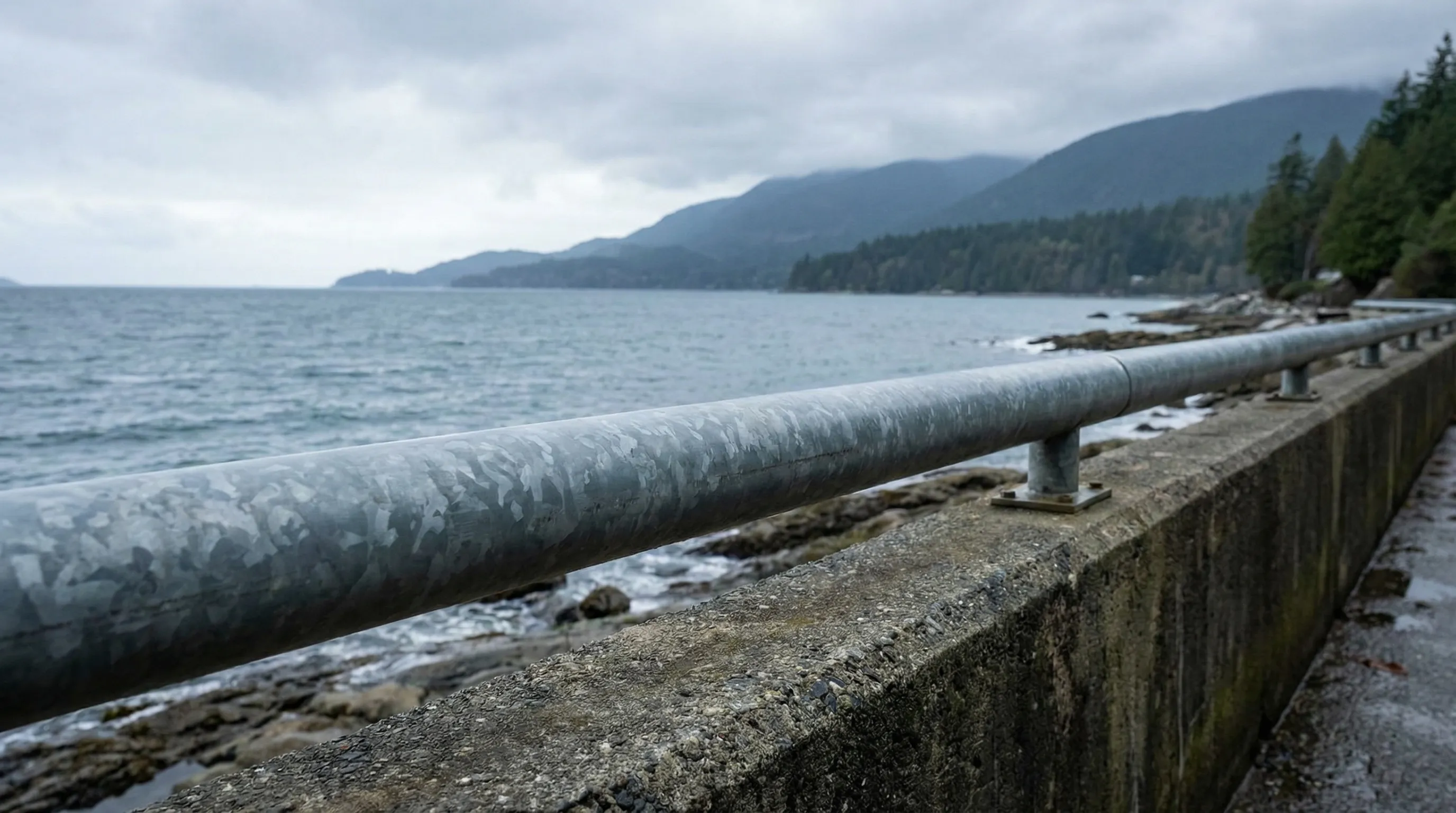
Not every coastal project needs 316L. For most Metro Vancouver waterfront work that’s near the water but not in the splash zone, a well-detailed duplex system — hot-dip galvanizing plus a marine-grade polyester powder coat on mild steel — is a better economic choice and still holds up for 25–40 years. We covered the numbers in galvanizing vs. powder coating for Vancouver’s coast.
The rough decision rule we use at the shop:
- Inland and general residential (Burnaby, Coquitlam, central Vancouver) — powder-coated mild steel is fine
- Near-coast, sheltered from direct spray (West Side Vancouver, Port Moody, Kitsilano waterfront) — duplex system on mild steel
- Direct waterfront, above high tide, exposed to wind-driven spray (most West Vancouver estates, North Vancouver waterfront, Deep Cove) — duplex system or 316L, depending on budget and aesthetics
- Splash zone or near-continuous salt exposure (seawall tops, docks, piers, exposed points) — 316L stainless only
Fabrication and welding — where marine projects actually fail
Material grade is half the story. The other half is fabrication discipline. The most common failure we see on “marine” projects fabricated by shops without the right procedures:
Carbon steel contamination. Grinding disks, wire brushes, and bench surfaces that have touched regular steel leave iron particles embedded in the stainless surface. Those particles rust in salt air and leave visible tea staining across otherwise pristine 316L. A proper marine fabrication process uses dedicated stainless-only tools, brushes, and work surfaces.
Incorrect welding procedure. Marine stainless needs TIG (GTAW) welding with matching 316L filler metal. The weld root has to be back-purged with argon to prevent oxidation on the inside of the weld. After welding, the heat-affected zone is cleaned with pickling paste to dissolve heat tint and restore the passive chromium oxide layer. Shops that skip back-purging or pickling leave chromium-depleted zones along every weld that will corrode before the parent metal.
Mixed fasteners. A 316L railing assembled with 304 or zinc-plated bolts creates a galvanic couple — the less noble metal corrodes preferentially. All fasteners, washers, and mounting hardware on a 316L project should also be 316 stainless. We’ve replaced railings that looked “marine grade” in the brochure but had failed at every zinc-plated anchor bolt.
Galvanic coupling with aluminum or plain steel. Where a stainless railing meets an aluminum post sleeve, window frame, or a carbon steel embed plate in concrete, the junction needs an insulating separator — typically a neoprene gasket and nylon isolation sleeves on through-bolts. Without it, one of the metals is going to corrode, and it’s usually the one you weren’t expecting.
What the install detail has to handle
Installation is where a lot of otherwise good marine projects get ruined. The details we insist on at every coastal Jeff and Simon install:
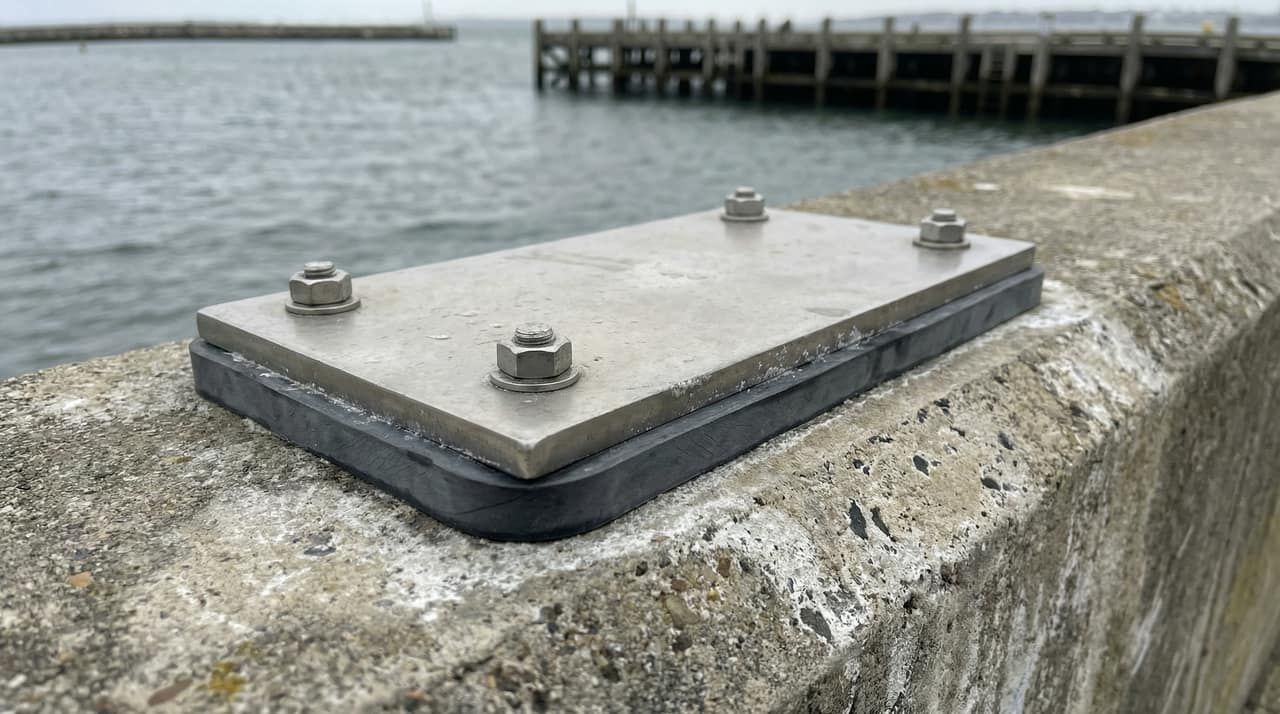
- Base plates on concrete seawalls and deck edges — neoprene isolation pad under the plate to separate the stainless from any embedded rebar, plus 316 stainless anchor bolts with isolation washers
- Drainage paths at the base of posts and corners — standing water inside a hollow post or at a bad flashing detail will cause crevice corrosion even in 316L
- No dissimilar metals in direct contact — no zinc-plated anchors, no aluminum sleeves over stainless posts without isolation
- Clearance from carbon steel structural embeds — at least 15 mm separation with an isolation gasket on any railing post that mounts near existing carbon steel
- Post-install cleaning and passivation — fresh water rinse of the entire assembly and a passivation treatment on welded zones to restore chromium oxide
Real Metro Vancouver project examples
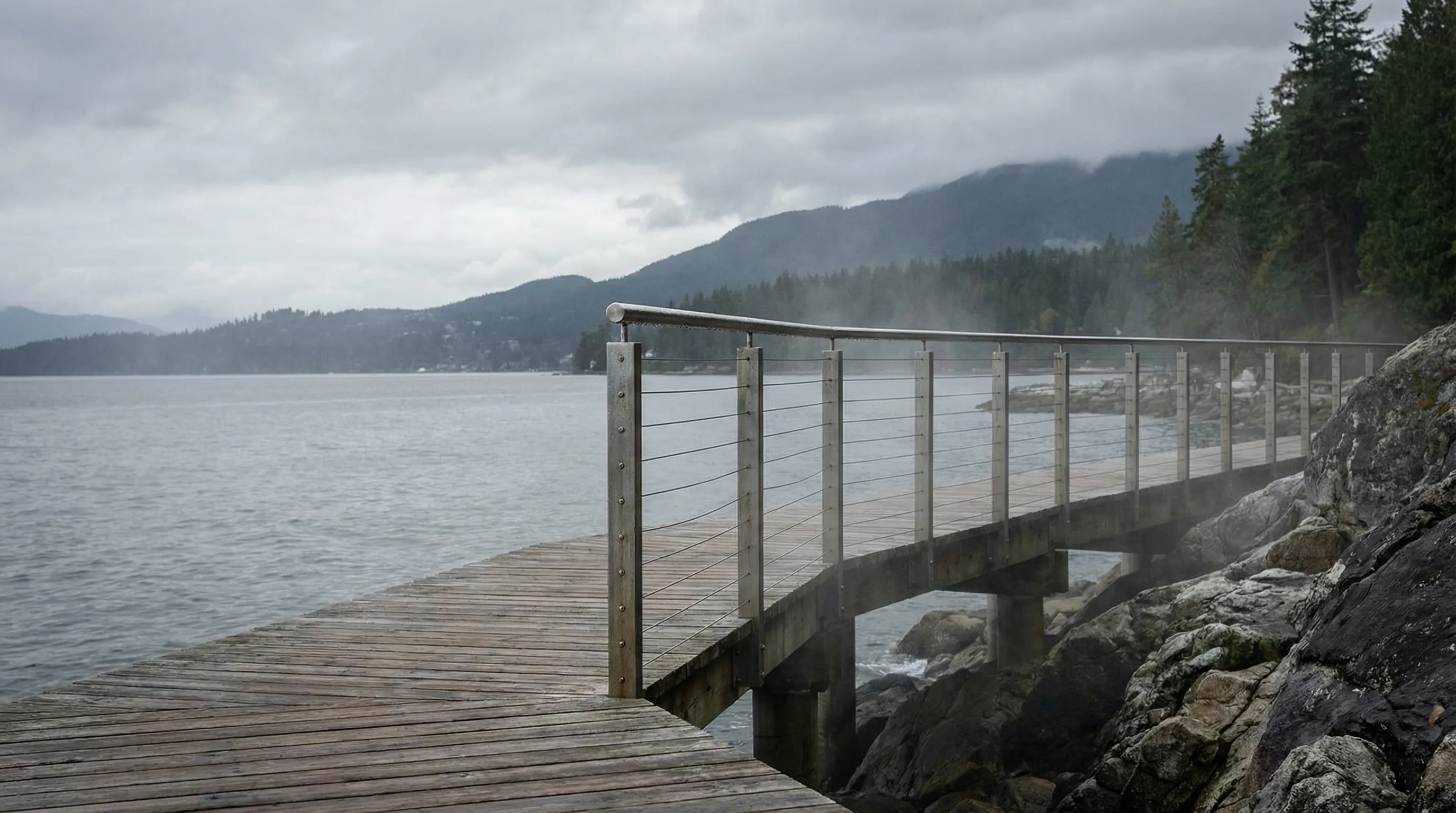
- West Vancouver waterfront cable railing, 80 ft, 316L posts and cable, brushed satin finish, stainless base plates — $48,000–$72,000 installed. Expected life: 30+ years with annual rinsing
- North Vancouver deck glass railing with 316L posts and top rail, 60 ft, glass infill, coastal exposure — $35,000–$55,000. Expected life: 25–35 years
- Deep Cove waterfront gate and fence system, 40 ft fence plus single gate, 316L fabrication, stainless hardware — $55,000–$90,000. Expected life: 25+ years
- West Vancouver driveway gate, duplex-finished carbon steel (not full marine grade but excellent value near the water) — $12,000–$22,000. Expected life: 20–30 years
The premium for true 316L construction over a duplex carbon steel alternative is real — typically 80–150% on the railing scope — but for the owners of direct waterfront properties on the North Shore and Sea-to-Sky, the cost of replacing a failed railing in five years is a lot higher than the cost of speccing it right the first time.
How to read a “marine-grade” quote
When a competing shop offers a “marine-grade” railing at a low price, the questions to ask:
- What material grade? If the answer isn’t “316L stainless” or “hot-dip galvanized and powder-coated mild steel,” it’s not marine grade
- What filler metal on the welds? Should be 316L matching filler, TIG welded with back-purge
- What’s the fastener spec? All 316 stainless on a 316L project
- Are there isolation details where the railing meets other metals or concrete embeds?
- Is there a post-install passivation step on welded stainless?
If the shop can’t answer all five without hesitating, the railing isn’t going to survive Metro Vancouver’s coastal exposure regardless of what’s written on the brochure.
For more on coastal finish selection, see our galvanizing vs. powder coating guide. For broader railing selection, the guide to custom railings in Vancouver covers material options across the full range of projects. If you’re starting a coastal Metro Vancouver project — West Vancouver, North Vancouver, Deep Cove, or a waterfront Squamish build — the conversation we want to have at the Burnaby shop is about exposure and expected life, not brochure specs.