Most buildings in Metro Vancouver are wood-frame. That’s fine for a lot of residential work and low-rise commercial, but there’s a point where wood stops making sense — and steel starts. If you’re planning a project that needs long clear spans, carries heavy loads, or has to meet BC’s seismic requirements for a larger structure, structural steel is probably part of the conversation.
We fabricate structural steel at our Burnaby shop for residential and commercial projects across the Lower Mainland. This is the practical version of what you need to know before your project hits the fabrication stage — what drives the decision to use steel, what it costs, how BC’s seismic codes affect the design, and what to expect from the fabrication and erection process.
When a project needs structural steel
Steel shows up in a project for one of four reasons: the span is too long for wood, the load is too heavy, the geometry requires it, or the building code demands it.
Long clear spans. Open-concept living spaces are the norm in new Vancouver and Burnaby homes. When a designer wants a 24-foot span across a kitchen and living room with no intermediate posts, engineered lumber maxes out. A W310 or W360 steel beam handles that span without breaking a sweat — and at a fraction of the depth that an engineered wood option would need. Less depth means more ceiling height, which matters in Vancouver’s tight lot builds where every inch counts.
Heavy loads. A second-storey addition on a 1960s Burnaby rancher means the existing foundation and ground floor need to support an entire new level. Steel columns and beams can transfer those loads through the existing structure to the foundation without requiring the kind of massive wood posts that would eat into floor space.
Cantilevers and overhangs. Steel is the go-to for cantilevered balconies, canopy structures, and projecting floor plates. A 6-foot cantilever in wood requires a 12-foot back-span to counterbalance. In steel, the ratios are far more forgiving, and the connections are more compact.
Code requirements. Buildings over a certain height or area in BC must use non-combustible construction — which means steel or concrete. Most commercial projects above three storeys are going steel frame, concrete frame, or a hybrid.
Residential structural steel
On the residential side, most of our structural steel work falls into a few common scopes.
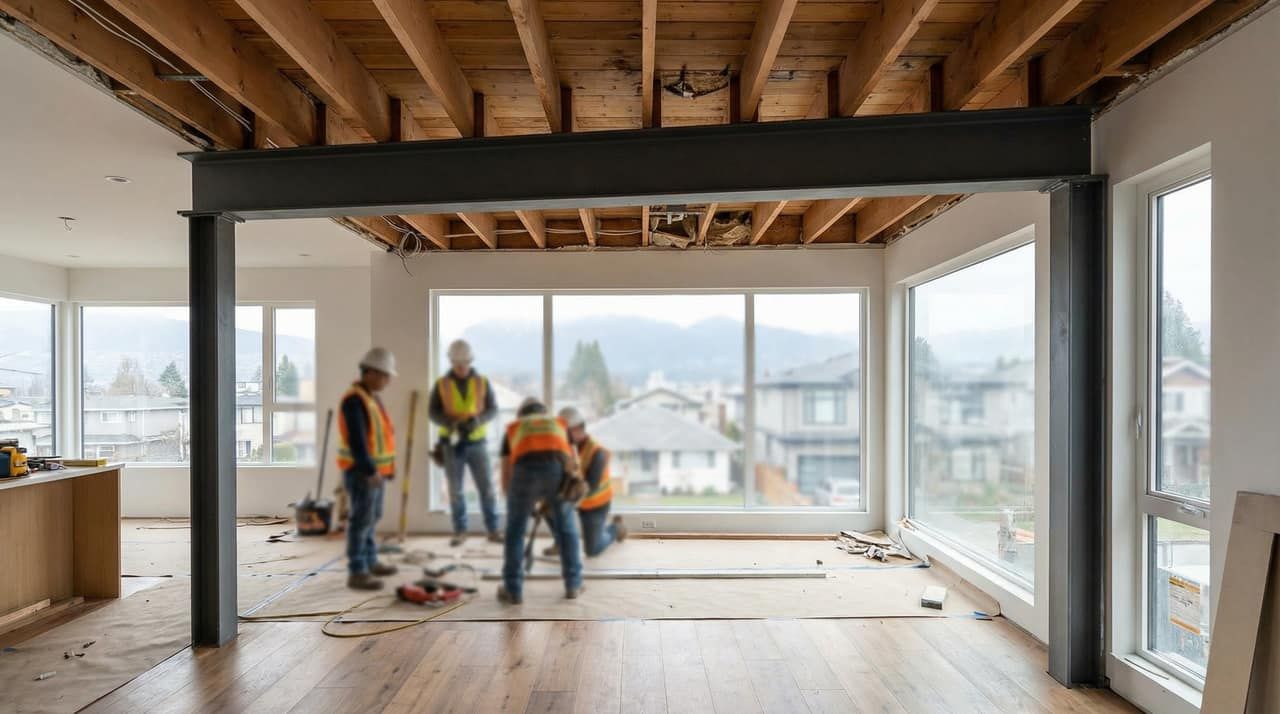
Beam packages for wall removals. This is the most common residential structural steel job in Metro Vancouver right now. A homeowner or contractor wants to remove a load-bearing wall to open up the main floor. The structural engineer designs a steel beam (usually a W-shape wide flange) supported by steel posts at each end, and we fabricate it to the engineer’s specs. A typical beam package for a single wall removal — one beam, two posts, base plates, and cap plates — runs $3,000–$6,000 fabricated and delivered.
Post-and-beam frames. Custom homes on the North Shore and in West Vancouver frequently use steel post-and-beam frames instead of conventional wood framing. The steel frame provides the primary structure — columns at the perimeter, beams spanning between them — and everything else (walls, roof, cladding) hangs off it. This allows floor-to-ceiling glass walls, dramatic double-height spaces, and cantilever decks that wood framing simply can’t achieve. A steel frame for a 3,000 sq ft custom home runs $40,000–$80,000+ depending on the complexity and tonnage.
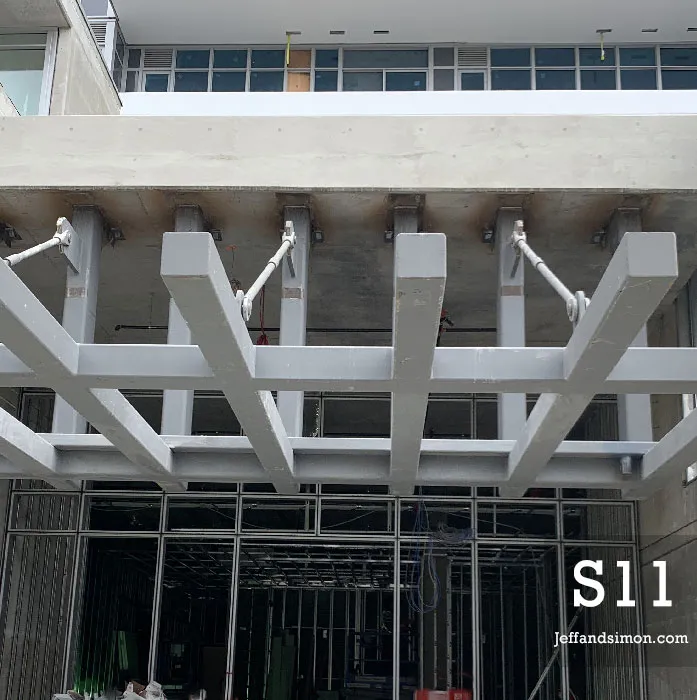
Canopy and awning structures. Steel canopy frames over entries, carports, and outdoor living areas are a growing scope. The structural requirements are modest compared to a building frame, but the fabrication needs to be precise because the steel is usually exposed and visible. We see a lot of these in North Vancouver and Squamish where the architecture leans toward modern West Coast aesthetics.
Garage-to-suite conversions. With BC’s push for secondary suites and laneway homes, we fabricate steel lintels and beams for garage-to-suite conversions where the existing garage opening needs a structural header, or where the garage floor slab is getting a new level built above it. These are typically smaller beam packages — $2,500–$5,000 for the steel fabrication.
Commercial structural steel
Commercial structural steel is a different animal. The tonnage goes up, the coordination gets more complex, and the schedule pressure is real.
Steel frames for mid-rise buildings. A four-to-six-storey commercial or mixed-use building in the Lower Mainland typically uses a steel moment frame or braced frame as its primary lateral system, with steel beams and metal deck forming the floor structure. The steel package for a building like this might be 50–200 tonnes, fabricated over 8–12 weeks and erected over 3–6 weeks. Coordination with the concrete subcontractor (foundations and podium), mechanical trades, and the general contractor’s master schedule is where the complexity lives.
Parking structures. Parkade steel — typically HSS columns with wide-flange beams — has its own detailing requirements because of vehicle loads, ramp geometry, and corrosion protection. Salt and moisture from vehicles chew through unprotected steel in a couple of winters. Hot-dip galvanizing or a heavy-duty coating system is mandatory.
Tenant improvements and mezzanines. Lighter commercial steel scopes include mezzanine floors in warehouse and industrial spaces, steel platforms for mechanical equipment, and structural modifications for tenant fit-outs. These projects are usually 2–10 tonnes of steel and can move quickly — 3–4 weeks from shop drawings to install.
BC seismic requirements and what they mean for steel
BC sits on the Cascadia Subduction Zone. Metro Vancouver is classified as Seismic Zone 4 under the National Building Code, with coastal areas reaching Zone 5. That classification shapes every structural steel design in the region — and it’s one of the reasons earthquake-resistant steel detailing matters so much here.
What seismic design means in practice for steel fabrication:
Moment connections. In a seismically active zone, beam-to-column connections can’t just be simple shear tabs. The engineer specifies moment connections — bolted or welded assemblies that transfer bending forces between the beam and column, allowing the frame to flex during an earthquake without collapsing. These connections require more steel (stiffener plates, flange plates, continuity plates) and more weld volume. They cost more to fabricate, but they’re what keeps the building standing.
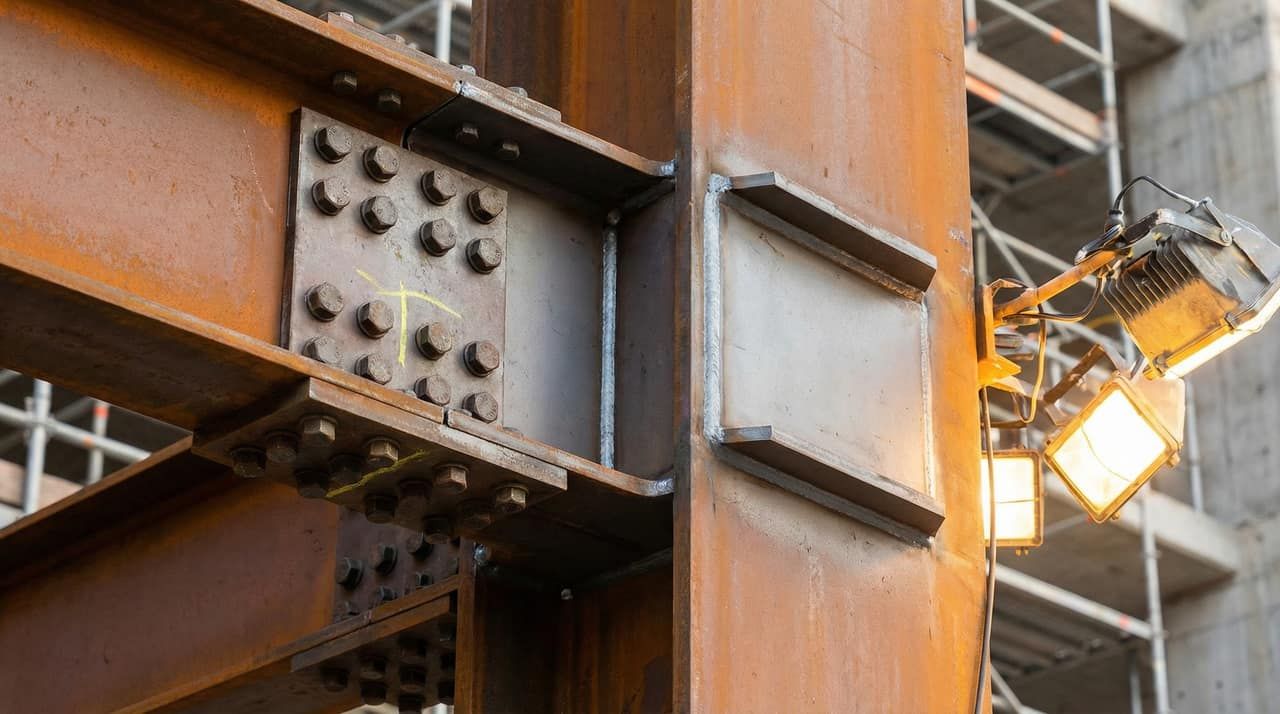
Ductile design. BC’s seismic provisions require certain steel frames to be designed as “ductile” — meaning they can absorb earthquake energy through controlled deformation rather than brittle failure. This affects member sizing, connection detailing, and weld specifications. A ductile moment-resisting frame (Type D) has strict rules about where plastic hinges can form and how connections must perform under cyclic loading.
Braced frames and concentric bracing. Not every building uses moment frames. Many use braced frames — diagonal steel members that resist lateral loads. In seismic zones, the bracing must be designed to yield in tension and buckle in a controlled manner in compression. The connections at each end of the brace are often the most heavily detailed part of the entire steel package.
Weld quality requirements. Seismic connections often require complete joint penetration (CJP) welds rather than fillet welds, and those CJP welds frequently need ultrasonic testing (UT) to verify full fusion. This is where CWB certification becomes non-negotiable — the quality control procedures, welder qualifications, and inspection protocols that C.W.B. audits are specifically designed to catch deficiencies in this kind of work.
Engineering and permits
Structural steel doesn’t start in the fabrication shop. It starts with the structural engineer.
The engineer designs the steel members, selects the grades and sizes, details the connections, and produces sealed structural drawings. Those sealed drawings go to the municipality as part of the building permit application. In Burnaby, Vancouver, and most Lower Mainland municipalities, you can’t pull a permit for structural steel work without an engineer’s sealed design.
Once the permit is issued and the engineer’s design is finalized, the fabricator produces shop drawings. Shop drawings are the fabrication-level detail — every cut length, bolt hole location, weld symbol, and piece mark that the shop floor needs to build the steel. The engineer reviews and approves the shop drawings before fabrication starts. Changes after this point are expensive.
On commercial projects, the shop drawing process includes coordination with other trades. The steel fabricator needs to know where mechanical penetrations go through beams, where concrete embeds land in the slab, and what the erection sequence looks like relative to the GC’s schedule. RFIs fly back and forth. A good structural steel scope runs smoothly when the coordination happens early — and gets messy when it doesn’t.
For residential work, the process is simpler but follows the same logic: engineer designs, fabricator produces shop drawings, engineer approves, shop fabricates, crew installs.
CWB certification: what it means and why it’s required
CWB certification under CSA W47.1 is the Canadian standard for welding quality in steel fabrication. It’s not optional for structural work — it’s a legal requirement in BC.
A C.W.B. certified shop has been audited by the Canadian Welding Bureau for welder qualifications (each welder is tested and certified for specific positions and processes), welding procedure specifications (the shop has documented, qualified procedures for every type of joint), quality control (the shop has an internal inspection program), and equipment calibration.
What this means for your project: every structural weld on the steel we fabricate at our Burnaby shop has been performed by a qualified welder following an approved procedure, and inspected against the applicable code. When an engineer specifies CJP welds with UT inspection on your seismic moment connections, our C.W.B. program is the framework that makes sure those welds actually meet the spec — not just on paper, but in the shop.
We’ve written about what C.W.B. certification actually involves in more detail. But the short version: if a fabricator can’t show you a current C.W.B. certificate, they can’t legally weld structural steel for a permitted building in BC.
What structural steel costs in 2026
Steel pricing fluctuates with the commodity market, but here are the ranges we’re seeing in Metro Vancouver in 2026.
Residential beam packages (1–4 beams, columns, base plates): $3,000–$20,000. A single beam for a wall removal sits at the low end. A full post-and-beam frame for a custom home pushes well above the high end. The big variables are tonnage, connection complexity, and finish requirements. If the beams are getting buried in the wall and ceiling, a basic primer finish works. If they’re exposed as a design feature, powder coating or a clear-coat finish adds $2,000–$5,000 to the package.
Commercial steel frames: pricing is per-project because the variables are too wide for a useful per-tonne number in isolation. A 50-tonne steel package for a four-storey mixed-use building in Burnaby might run $150,000–$250,000 for fabrication alone (excluding erection). A 10-tonne mezzanine in a Port Coquitlam warehouse is $30,000–$50,000. The driver isn’t just weight — it’s connection count, member variety, and how much shop time each piece requires. A tonne of simple W-beams with shear tabs is far less expensive per tonne than a tonne of moment-connected beams with stiffeners, continuity plates, and CJP welds.
Erection costs are separate from fabrication. Crane rental, rigging crew, and bolt-up crew add 20–40% on top of the fabrication number for most projects. Site access in tight Metro Vancouver lots — especially in Vancouver’s east side and New Westminster — can push crane costs higher because of road permits, power line clearances, and limited laydown area.
The fabrication and erection process
Here’s what the timeline looks like from when the steel scope lands on our desk to when the last bolt gets torqued on site.
Shop drawing development (1–3 weeks). Our detailing team produces fabrication-level drawings from the engineer’s structural design. Every member gets a piece mark, a cut list, and connection details. The engineer reviews and stamps the shop drawings.
Material procurement (1–2 weeks, sometimes longer). We order steel from local suppliers — wide-flange beams, HSS sections, plates, and connection hardware. In 2026, lead times for common shapes (W310, W360, HSS 152x152) from BC-based suppliers are typically 1–2 weeks. Specialty sections or heavier shapes can take 3–4 weeks.
Fabrication (2–6 weeks depending on tonnage). Cutting, drilling, fitting, welding, grinding, and finishing. Every structural weld follows our C.W.B. qualified procedures. Pieces are trial-assembled in the shop where geometry is complex — if a moment connection doesn’t fit on the shop floor, it won’t fit on site.
Finishing (1–2 weeks, overlapping with fabrication). Primer, powder coating, galvanizing, or specialty finish depending on the spec. Structural steel that’s getting fireproofed on site usually gets a basic shop primer. Exposed steel gets a more durable finish.
Delivery and erection (1–5 days for residential, 1–6 weeks for commercial). Residential beam packages often go in with a small crane or a boom truck in a single day. Commercial steel erection involves a larger crane, an ironworker crew, and a phased erection sequence that coordinates with the concrete and deck trades.
Projects that show what this looks like in practice
Two projects from our portfolio illustrate the range of structural steel work we handle.
Herman Church, Langley. A heritage church restoration and expansion that required new structural steel to support the renovated roof structure and expanded nave. The steel had to integrate with existing timber framing from the original building — which meant field-verifying every connection point before fabrication, because the as-built conditions didn’t match the original drawings (they rarely do on heritage structures). The scope included custom steel trusses, moment-connected columns, and concealed connections where the steel met the heritage timber. You can see more of this project on our steel structures project page.
Rosewood Hotel Georgia, Vancouver. One of Vancouver’s most recognized heritage hotels. Our scope on this project included architectural metalwork and structural steel support elements for the renovation — steel framing for new interior configurations, support structures for decorative elements, and coordination with the heritage consultant’s requirements for reversible connections (nothing permanently attached to the original structure). Working on a downtown Vancouver heritage building means tight site access, noise restrictions, and exacting quality standards. The Rosewood project demanded precision fabrication and careful sequencing — the kind of work where C.W.B. certification isn’t just a formality.
Both projects — one a community building in the Valley, the other a luxury hotel in the urban core — required the same underlying discipline: accurate shop drawings, qualified welding, and a fabrication shop that can deliver on schedule.
Choosing a structural steel fabricator
Not every metal shop handles structural steel. Ornamental fabricators, railing shops, and general welding operations may not carry C.W.B. certification for structural work, and they may not have the equipment or detailing capability to handle a structural scope.
When you’re selecting a fabricator for a structural steel project in BC, here’s what to verify:
Current C.W.B. certification to CSA W47.1, Division 2 or higher. Ask for the certificate — it lists the division, the certified welding processes, and the expiry date.
In-house shop drawing capability. A shop that outsources detailing adds a communication layer and often adds time. We detail in-house, which means our detailers and fabricators are in the same building, looking at the same steel.
Capacity for your project size. A shop running one saw, one drill, and two welders isn’t going to turn around a 40-tonne commercial scope in six weeks. Ask about current workload and lead times.
Experience with your project type. Residential beam packages and commercial moment frames are different fabrication disciplines. A shop that does one well doesn’t automatically do the other.
If you’re at the planning stage on a project that involves structural steel — whether it’s a wall removal in a Burnaby rancher or a multi-storey commercial frame in New Westminster — get in touch with our shop. We’ll talk through the scope, give you a realistic timeline, and connect you with a structural engineer if you don’t have one yet.