Cost guide — Metro Vancouver
What affects metal staircase pricing
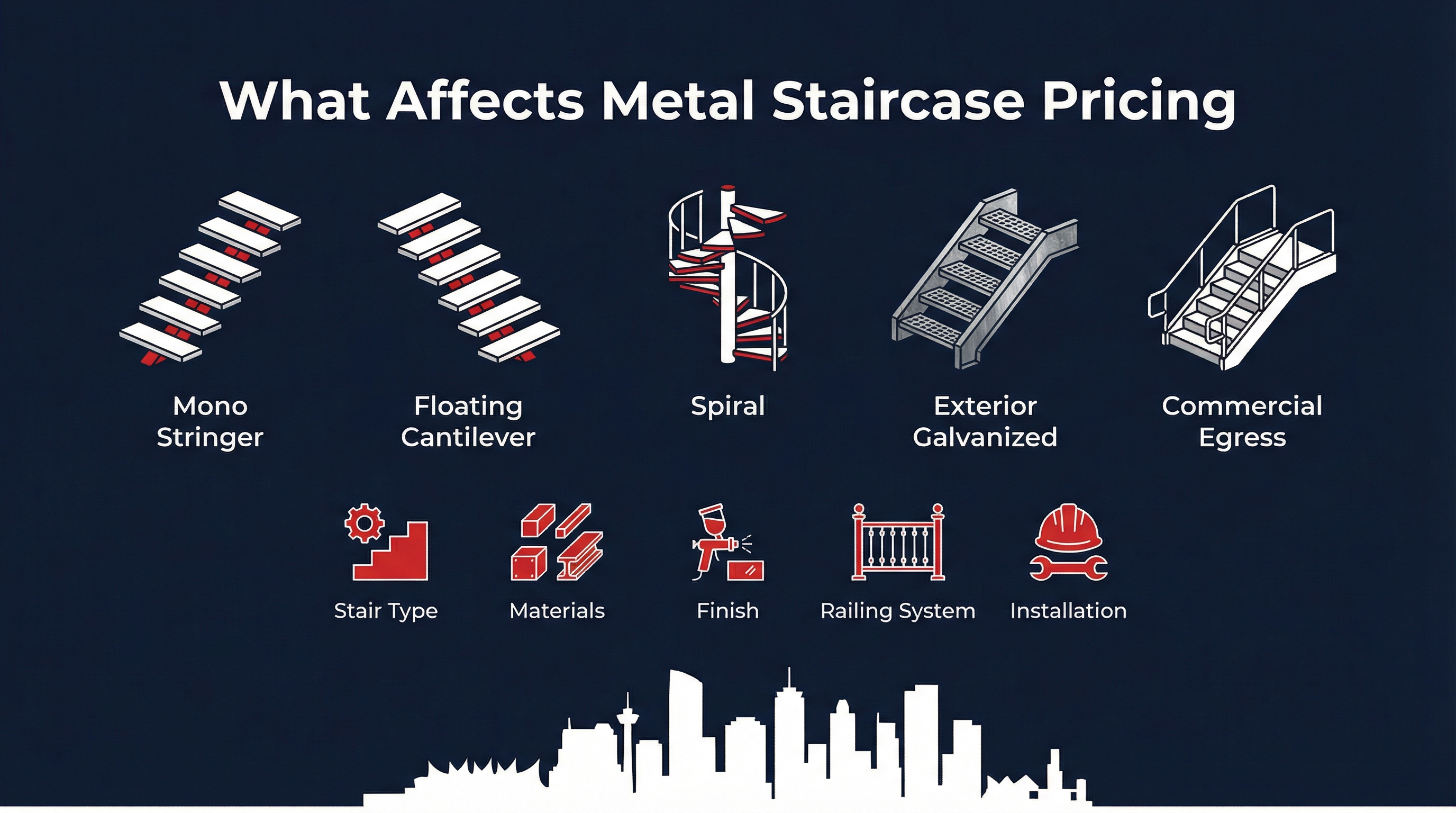
There is no single price for a custom metal staircase. The cost depends on stair type, span, materials, finish, railing system, and installation conditions. This page explains what drives the price for each stair type we build in Metro Vancouver — so you can understand what affects your project budget before you request a quote.
Stair types and relative cost complexity
| Stair type | Description | Relative cost level |
|---|---|---|
| Mono stringer (basic) | Straight run, 14 treads, oak, powder coat, steel railing | Standard |
| Mono stringer (premium) | Switchback, walnut treads, glass railing, custom finish | Higher — glass railing and landing add cost |
| Floating cantilever (typical) | Straight run, 12 treads, oak, glass railing | Higher — embedded wall structure required |
| Floating cantilever (premium) | Switchback, stone treads, frameless glass, integrated lighting | Highest residential tier |
| Spiral (residential) | 5 ft diameter, single rise, hardwood treads | Moderate — varies by diameter and tread material |
| Spiral (exterior galv) | 5 ft diameter, checker plate treads, galvanized | Moderate — galvanizing offsets simpler finish |
| Exterior galvanized straight run | 8–12 treads, deck access, with railing | Entry-level for custom stairs |
| Commercial egress (single flight) | 1100 mm wide, concrete pan treads, painted | Quoted per project based on scope |
Mono stringer stairs start from $18,000 for a standard residential configuration. Other stair types are priced based on project-specific scope. For an accurate number, request a quote with your project details — we turn around budgetary pricing in 2–5 business days for most residential scopes.
What the cost components are — mono stringer example
A custom mono stringer stair quote is built from these components. Each one is a lever that moves the total price up or down:
- Engineering and shop drawings: Structural engineering, 3D modelling, and code review. More complex stairs (switchbacks, longer spans) require more engineering time.
- Steel material (stringer, brackets, hardware): The stringer section depth and steel weight are driven by span and load. Longer spans need deeper, heavier stringers.
- Fabrication labour (cutting, welding, assembly): The largest single component. More treads, more brackets, and more complex geometry mean more welder hours.
- Tread material (oak, walnut, stone): Oak is the cost-effective default. Walnut costs meaningfully more. Stone treads are the premium option and also affect the stringer engineering because of the weight.
- Finishing (powder coat or paint): Standard colours are the baseline. Custom RAL colours, textured finishes, and metallic powder coat each step up in cost.
- Railing system (steel, glass, cable): This is often the second-largest component after fabrication labour. Steel picket is the most cost-effective; frameless glass is the most expensive.
- Delivery and installation: Includes site delivery, crane (if required), structural connection, and any field welding.
What drives floating stairs into a higher bracket
Floating cantilever stairs cost roughly 1.5 to 2 times a comparable mono stringer because of the embedded structure required in the wall. The cost components that get meaningfully bigger:
- Engineering: The cantilever moments at every tread require detailed structural analysis — more engineering hours than any other stair type
- Wall pocket steel (the hidden structural beam): A significant amount of structural steel and fabrication time goes into the beam the homeowner never sees
- Coordination during framing: Multiple site visits are required to verify the embedded structure before drywall closes in
- Installation precision: The treads have to land at exact heights with no visible support — installation is slower and more demanding
What drives commercial stair costs
Commercial egress stairs are quoted per project, but the cost drivers are predictable:
- Stair width — driven by occupant load. A 1100 mm stair is significantly cheaper than a 1500 mm stair on the same height because the tread plates and supporting structure scale with width.
- Number of flights — most commercial stairs have intermediate landings every storey. Each landing adds material and fabrication.
- Tread system — concrete-filled metal pans are the budget option; precast concrete or stone treads add cost.
- Fire rating — non-combustible structural steel is standard; the fire-rated shaft enclosure is usually a separate trade (drywall, framing).
- Finish — interior commercial stairs are usually painted or powder coated; exterior stairs are galvanized; high-end interiors use stainless or architectural coatings.
What we do not charge for
We do not charge for the initial quote or budgetary pricing. For most residential scopes we can give you a meaningful number from drawings, photos, or a phone conversation in 2–5 business days. If the project is complex enough that we need a site visit to quote accurately, we do those at no charge within the Lower Mainland.
How to get a quote
Send what you have — architectural drawings, framing photos, a sketch on a napkin, or a description in plain language. Email info@jeffandsimon.com, call +1 (604) 294 0409, or use the request a quote form. We will review what you have and follow up with pricing or with the questions we need answered to price it.
What you get at different complexity levels
Another way to think about the cost question: not by stair type, but by complexity and finish level.
Entry level: utility-focused stairs
Exterior galvanized deck stairs, small custom spiral staircases, or simple interior mono stringers with the most cost-effective tread and finish options. This level works for utility-focused applications — deck access, loft access, secondary stairs — but it won't deliver a statement piece for the living room.
Standard residential: mono stringer stairs
The sweet spot for residential projects. A properly engineered modern mono stringer stair (starting from $18,000) with oak treads, a simple steel railing, matte black powder coat finish, and professional installation. This is where most of our custom home stair projects land.
Premium residential: upgraded materials and railing
A mono stringer with walnut treads, a glass railing, and custom colour finishes — or a straightforward floating stair. At this level, the stair becomes a real architectural element that anchors the entry or the open living space.
Luxury residential: floating stairs and premium finishes
Floating stairs with premium treads (walnut, stone), frameless glass railings with custom hardware, integrated LED lighting, architectural finishes. This is where the stair is the centrepiece of the home and the scope reflects that.
Signature architectural: one-off sculptural pieces
Double-landing floating stairs, bespoke hardware and finishes, tight coordination with architects and interior designers. Rare but not unheard of on high-end Vancouver West Side homes.
For a project-specific number at any level, request a quote. We turn around budgetary pricing in 2–5 business days for most residential scopes.
Related reading
For details on specific stair types, see the mono stringer, floating stairs, spiral, and commercial egress guides. For the underlying fabrication process, read the shop drawings & process page.
FAQs about stair pricing
Why are custom metal stairs so expensive?
Custom metal stairs are expensive because they are engineered, fabricated, finished, and installed as one-off products — not assembled from a kit. Every stair requires structural engineering, shop drawing time (8–20 hours), fabrication (30–80 hours of welder time), a separate finishing process (powder coat or galvanizing), and skilled installation that often requires a crane. The cost reflects all of that professional time and material.
What is the cheapest way to get a metal staircase?
For utility access, prefab spiral kits from third-party suppliers are the lowest-cost option — fine for loft access, secondary stairs, or industrial use, but limited in dimensions and finish. For a custom stair, the most cost-effective option is a straight-run mono stringer in mild steel with powder coat finish, oak treads, and a simple steel picket railing — mono stringer stairs start from $18,000 in Metro Vancouver. <a href="/request-a-quote/">Contact us for a quote</a> on your specific project.
How do I get an accurate quote?
Send us drawings, sketches, photos, or even a description of the project. The more we know — span, total rise, number of treads, finish preference, surrounding structure — the more accurate the quote will be. For most residential scopes we turn around budgetary pricing in 2–5 business days. For commercial projects, we handle the full RFI and submittal process and provide formal quotes during the tender phase.
What drives the cost up the most?
Three things drive cost more than anything else: structural complexity (a floating cantilever costs roughly twice what a mono stringer costs because of the engineering and embedded structure), tread material (stone treads cost several times more than oak), and finish (architectural powder coat with custom RAL colour costs more than standard colours; integrated LED lighting in stringers is a meaningful add). Railing system is the fourth — frameless glass railings often cost more than the steel structure under them.
How do Vancouver stair prices compare to other Canadian cities?
Metro Vancouver metal stair prices tend to run higher than comparable projects in Calgary or Edmonton, and roughly in line with Toronto. The drivers are labour rates (BC trades cost more than Alberta), seismic engineering (BC code requires more detailed structural analysis), and material markup (Vancouver steel distributors run higher margins than prairie distributors). The differences narrow on premium projects where material and engineering dominate.
Do prices include GST?
All prices on this page and in our quotes are stated before GST. Final invoices include 5% GST on the fabrication and installation charges. For most residential projects, GST is not recoverable; for commercial projects, it is recoverable through input tax credits for GST-registered businesses.
How are deposits and progress payments handled?
For residential projects, we typically take a 50% deposit at shop drawing approval (which secures the material and fabrication slot), with the balance due on installation. For commercial projects, we follow the GC's payment schedule — usually monthly progress billing against a construction schedule of values. For very large scopes, we sometimes phase payments around material procurement, fabrication completion, and installation.
Is engineering included in the quote?
For residential scopes, yes — structural engineering and shop drawings are included in our quoted price as a standard part of the deliverable. For commercial scopes, structural engineering is usually provided by the project structural engineer (not us), and we quote only for shop drawings, fabrication, finishing, and installation. The exact scope is clarified during quoting.
What if I want to phase the project — stair now, railings later?
Possible, with trade-offs. Separating the stair structure from the railing means two mobilizations, two design reviews, and some coordination overhead. Phasing adds meaningful cost over an integrated quote. If the budget or schedule requires phasing, we can do it — but if both phases are known from the start, the integrated approach is almost always cheaper.
How do you handle price locking if the project slips?
For most projects, our quoted price is valid for 30–60 days. Beyond that, steel prices and material lead times can shift enough that we need to requote. For projects locked in with a deposit and approved shop drawings, the price is held for the duration of the schedule as long as scope doesn't change. Material price fluctuations for specialty items (stainless, aluminum, imported hardware) are passed through with documentation.
What finishes add cost and which don't?
Standard powder coat colours (matte black, charcoal, RAL 7016, RAL 9005) are usually priced the same — the coating cost is identical regardless of standard colour. Custom RAL colours, textured powder coat, and metallic powder coat each step up in price from there. Brushed or polished stainless mechanical finishes are quoted based on the visible surface area. Galvanizing adds to the total fabrication cost depending on assembly weight. We can break down finish options and their relative cost impact during quoting.
Is installation included or is it a separate line item?
For residential projects, installation is typically included as part of the quoted price. For commercial projects, we break out fabrication, delivery, and installation as separate line items so the GC can see the cost of each component. Either way, the installed price is what matters — we don't play games with "material only" quotes that leave installation as a surprise add-on.
Get in touch
Need a fabrication quote?
Send drawings, photos, or even a rough description. We will review what you have and follow up with a quote or a conversation about next steps.