
Stair type guide
Mono stringer metal stairs
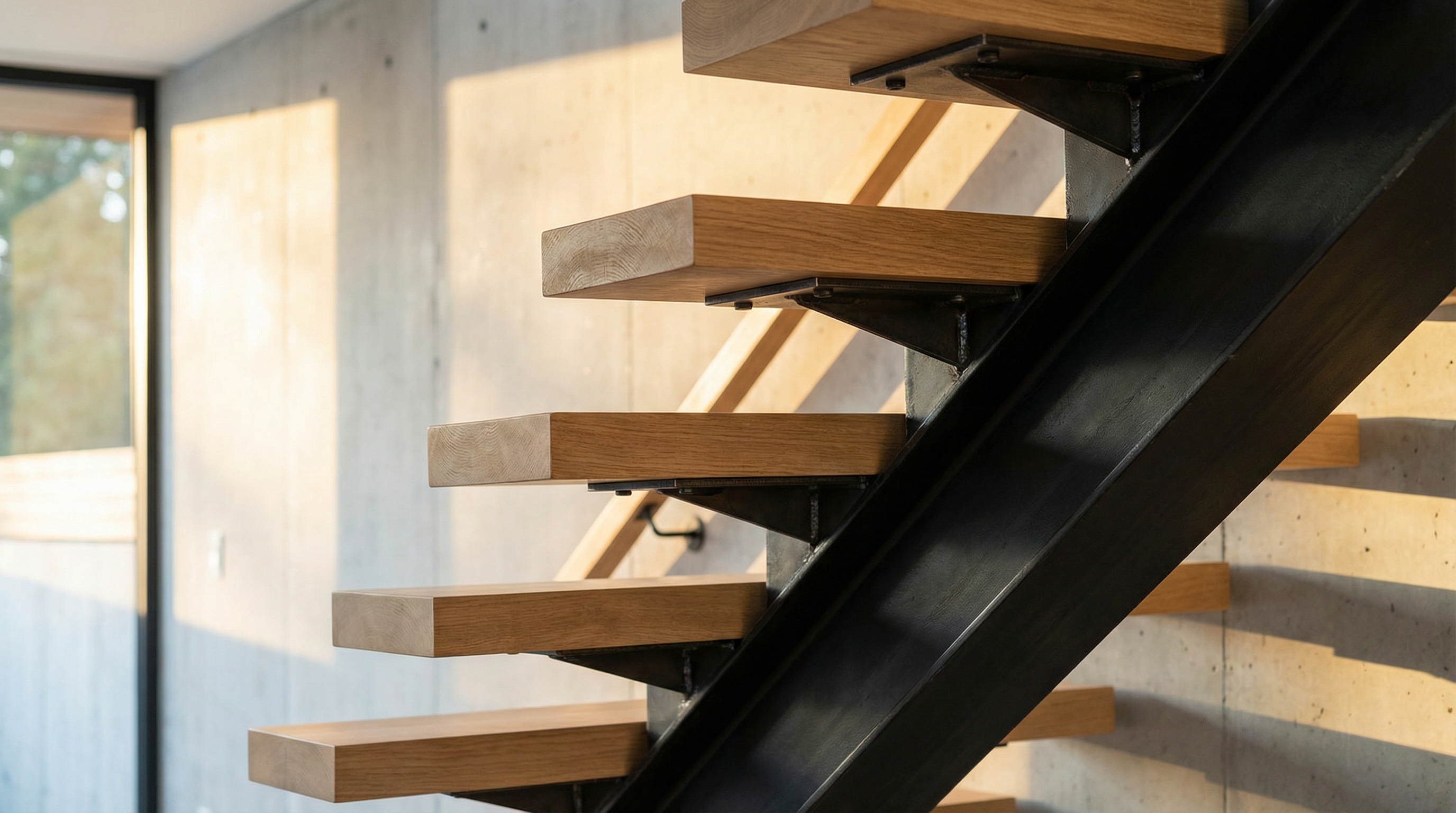
The mono stringer stair is the most-requested modern stair design in Metro Vancouver homes built in the last decade. A single steel beam runs the length of the stair; treads cantilever off both sides; the result is an open, sculptural staircase that doubles as the centerpiece of the room. Done well, it looks effortless. Done badly, it bounces, deflects, or shows distortion at every weld. The difference is in the engineering and shop discipline.
How a mono stringer stair is engineered
The stringer is the entire structural system. Everything else — treads, brackets, railings — hangs off it. That puts a lot of load through one member, so the section depth matters more than people expect. For a typical 14 ft residential run, we use a 10-inch by 4-inch HSS tube or a built-up plate section with a flange depth of 10–12 inches. Anything shallower will deflect under live load and feel bouncy underfoot, even if the stress numbers check out.
The connections at top and bottom are where the design either works or doesn't. The top connection ties into a structural beam or wall — usually with a welded plate and bolted connection sized by a structural engineer. The bottom connection is either a base plate bolted to a slab or, for a floating-look variant, embedded into the floor structure.
Seismic considerations apply here too. In Vancouver's seismic zone, the stringer-to-structure connections have to account for the horizontal loads that get transferred during an earthquake. That usually means more bolts, heavier plates, or welded connections where a simpler bolted connection would have worked in a less demanding zone.
Tread brackets — the detail that defines the stair
The treads cantilever off the stringer through brackets welded to either side of the central beam. The bracket detail is what people see when they look at the stair from the side, so it carries the visual weight of the design.
- Plate brackets: Flat steel plates welded perpendicular to the stringer, with the tread bolted on top. Cleanest look. Most common.
- Folded brackets: Plates bent into a U or L shape that wraps under the tread. More structural, slightly busier visually.
- Concealed brackets: Steel armature embedded inside the tread itself. Most expensive, gives the impression that the treads float off the stringer with no visible support.
Weld quality on the brackets is visible. A badly welded bracket creates a lumpy transition between the stringer and the plate that shows through even after powder coat. This is one of the reasons shop discipline matters on a mono stringer — the welds aren't hidden inside a wall cavity, they're on display.
Tread materials
The most common combinations we build in Vancouver homes:
- Solid white oak, 2 inch thick: Workhorse choice for modern homes. Looks warm, finishes well, structurally fine for residential loads.
- Solid walnut, 2.5 inch thick: Premium choice. Darker, richer grain, and a meaningful step up in material cost from oak.
- Engineered wood with steel core: Used where the architectural intent is wood but the load or fire rating requires more structural capacity.
- Stone (marble, granite, basalt): Used in high-end applications. Heavy — affects the stringer engineering. Beautiful but unforgiving on installation tolerances.
- Concrete-filled metal pan: For commercial projects where fire rating, durability, or matching surrounding concrete flooring is the priority.
Finish options
Most residential mono stringer stairs ship with a powder coat finish. The colour and texture options are wider than people expect:
- Matte black (RAL 9005): The default modern look. Clean, consistent, goes with almost any interior.
- Charcoal grey (RAL 7016): Slightly softer than pure black, reads better against bright white interiors.
- Custom RAL colours: Any RAL colour is available. Popular non-black choices include bronze, off-white, and deep navy.
- Textured powder coat: Fine texture powder coat hides minor imperfections and adds a tactile quality.
- Clear coat over raw steel: For an industrial look, the raw steel can be sealed with a clear coat that preserves the mill finish and weld marks. Requires careful shop prep.
Cost — what drives mono stringer stair pricing
Mono stringer stairs start from $18,000 for a standard residential configuration in Metro Vancouver. The final price is driven by stringer span and complexity, tread material (oak is the cost-effective default; walnut and stone cost more), railing system (steel picket is simplest; cable and glass railings add meaningfully), finish, and whether the stair includes a landing or switchback. For a project-specific number, request a quote — we turn around budgetary pricing in 2–5 business days.
Lead time
From approved shop drawings to installed stair, a mono stringer takes 8–12 weeks. The biggest variables are tread material lead time (custom milled hardwood can add 2–3 weeks) and finish (powder coat is 3–5 days, custom paint colors longer). For new builds, the stair typically goes in after drywall but before flooring — so the framer needs to leave the stair opening at the right dimension and the drywall needs to be cut clean to the stringer on the install day.
Common mistakes and how to avoid them
A few things we see on mono stringer projects that went wrong before we got involved:
- Undersized stringer: The stringer looks fine on paper but deflects under real use because the designer didn't account for the tread cantilever moments. Fix: work with an engineer who has done mono stringer stairs before.
- Wrong opening dimension: The framer rough-framed the stair opening without checking the stringer width plus the bracket projection plus clearance for drywall. Fix: we provide opening dimensions during shop drawings, not during installation.
- Tread material mismatch: The homeowner sourced treads at a different thickness than the fabricator assumed, so the brackets don't match. Fix: lock the tread material before shop drawings are finalized.
- Bracket spacing conflicts with guard code: The architect's rendering showed treads at 12 inch rise, but that doesn't match the actual floor-to-floor and ends up violating code on one tread. Fix: check tread count and rise math before committing to a rendering.
Related reading
If you're weighing mono stringer against other stair types, the metal stair fabrication hub has comparison information and the floating stairs page covers the main alternative for high-end interiors. The cost guide covers what drives pricing for every stair type we build.
FAQs about mono stringer stairs
What is a mono stringer stair?
A mono stringer stair uses a single central beam (the stringer) running the length of the stair to support the treads. The treads cantilever off both sides of the stringer, creating an open, modern look without the bulk of two side stringers. The stringer itself is usually a heavy steel tube or built-up plate section, sized by a structural engineer for the span and load.
How is a mono stringer different from a double stringer?
Double stringer stairs have two beams — one under each side of the treads. They are simpler to engineer and cheaper to fabricate, but they look heavier and the treads sit on top of the stringers. Mono stringer stairs put the entire load through one central beam, which means a deeper section, more welding, and more engineering work — but the visual result is dramatically lighter.
What spans can a mono stringer stair handle?
For typical residential stairs in Metro Vancouver, mono stringers handle 14–18 ft total run between supports. Beyond 18 ft, the stringer depth required to control deflection starts to dominate the design and usually pushes toward an intermediate landing. We have built mono stringer flights up to 22 ft on commercial scopes with 12-inch deep stringers.
What treads work with mono stringer stairs?
Almost any tread material works as long as the bracket detail supports it. The most common in Vancouver homes are solid hardwood (oak, walnut, fir) at 2–2.5 inch thickness, engineered wood treads with metal plate cores, and stone treads (marble, granite) for high-end applications. Glass treads are possible but require structural laminated glass and engineering review.
How much does a mono stringer stair cost in Vancouver?
Mono stringer stairs in Metro Vancouver start from $18,000 for a standard residential configuration. The final price depends on stringer span, tread material (oak vs walnut vs stone), railing system (steel picket vs cable vs glass), finish, and installation conditions. Premium finishes and exotic tread materials push the total higher. <a href="/request-a-quote/">Contact us for a project-specific quote</a> — we provide budgetary pricing in 2–5 business days.
What is the deflection limit on a mono stringer stair?
Most engineers specify a deflection limit of L/360 under full live load for residential stairs and L/480 for commercial. For a 16 ft span that's about 13 mm maximum deflection at midspan under a 1.9 kPa live load. Going beyond that limit makes the stair feel bouncy underfoot even when the stress numbers are fine. We design stringers with a healthy margin on deflection because it affects the perceived quality of the stair more than anything else.
Can a mono stringer stair have a landing mid-flight?
Yes. A landing breaks the stair into two flights and is a common solution for tall floor-to-floor heights or when the stair needs to turn 90° or 180°. The landing itself is a fabricated steel platform that ties into the wall structure or a column, and the upper and lower stringers connect to it. Landings add meaningful cost because of the additional steel, fabrication, and structural connections required, but they solve the span problem for stairs over 16–18 ft total run.
What is the bracket detail on the side of the stringer?
Each tread attaches to the stringer through a bracket welded to the side of the central beam. The three common bracket types are plate brackets (flat steel welded perpendicular to the stringer, tread bolted on top), folded brackets (L or U-shaped plates that wrap under the tread), and concealed brackets (steel armature embedded inside the tread itself). Plate brackets are the cleanest visually and the most common. Concealed brackets look like the treads float off the stringer but cost more because of the precision work involved.
Can I use glass treads on a mono stringer?
Yes, with engineering. Glass treads have to be structural laminated glass (typically 12mm + 12mm or 15mm + 15mm laminated with SGP interlayer) designed for the live load and edge fixing conditions. They look dramatic — especially over accent lighting built into the stringer — but they add significant cost per tread and require careful detailing around the brackets. Not every project is a good fit for glass treads. <a href="/request-a-quote/">Contact us</a> if you are considering glass treads and we can walk through the options.
Do mono stringer stairs work for commercial projects?
Yes. We build commercial mono stringer stairs for offices, restaurants, retail, and institutional projects where the architectural intent calls for a modern, sculptural stair. Commercial versions usually have heavier stringers (10–12 inch depth rather than 8 inch) because of the higher live load requirements (4.0 kPa vs 1.9 kPa residential) and often use concrete-filled metal pan treads instead of hardwood for fire rating and durability.
How heavy is a mono stringer stair?
A typical residential mono stringer stair with 14 treads weighs roughly 800–1500 lbs including the stringer, brackets, and treads. Commercial versions run 1500–3000 lbs. This matters for installation — the stair usually has to be craned or hand-set into position, and the weight affects the connection detailing at the top and bottom supports. We plan the installation method during shop drawings and coordinate any required crane access with the GC.
Can I add an integrated LED strip to the stringer?
Yes. Built-in LED lighting in the side of the stringer is increasingly common on high-end residential mono stringer stairs. The LED channel is machined or fabricated into the side of the stringer during shop fabrication, with wiring routed through the interior of the tube stringer and out at a concealed exit point. Cost depends on LED length, driver complexity, and whether the channel is integrated during fabrication or added later. Ask about this option when you <a href="/request-a-quote/">request a quote</a>.
Do you handle the wood treads or do I source them separately?
Either way works. We have sourcing relationships with local hardwood mills and can supply the treads as part of the package. Alternatively, if you have a preferred wood supplier or reclaimed wood you want to use, we can fabricate to match their thickness and dimension. The treads are typically installed on site after the stringer is set and painted, which makes it easy to use owner-supplied materials.
Get in touch
Need a fabrication quote?
Send drawings, photos, or even a rough description. We will review what you have and follow up with a quote or a conversation about next steps.