
Stair type guide
Exterior galvanized steel stairs for the Pacific Northwest
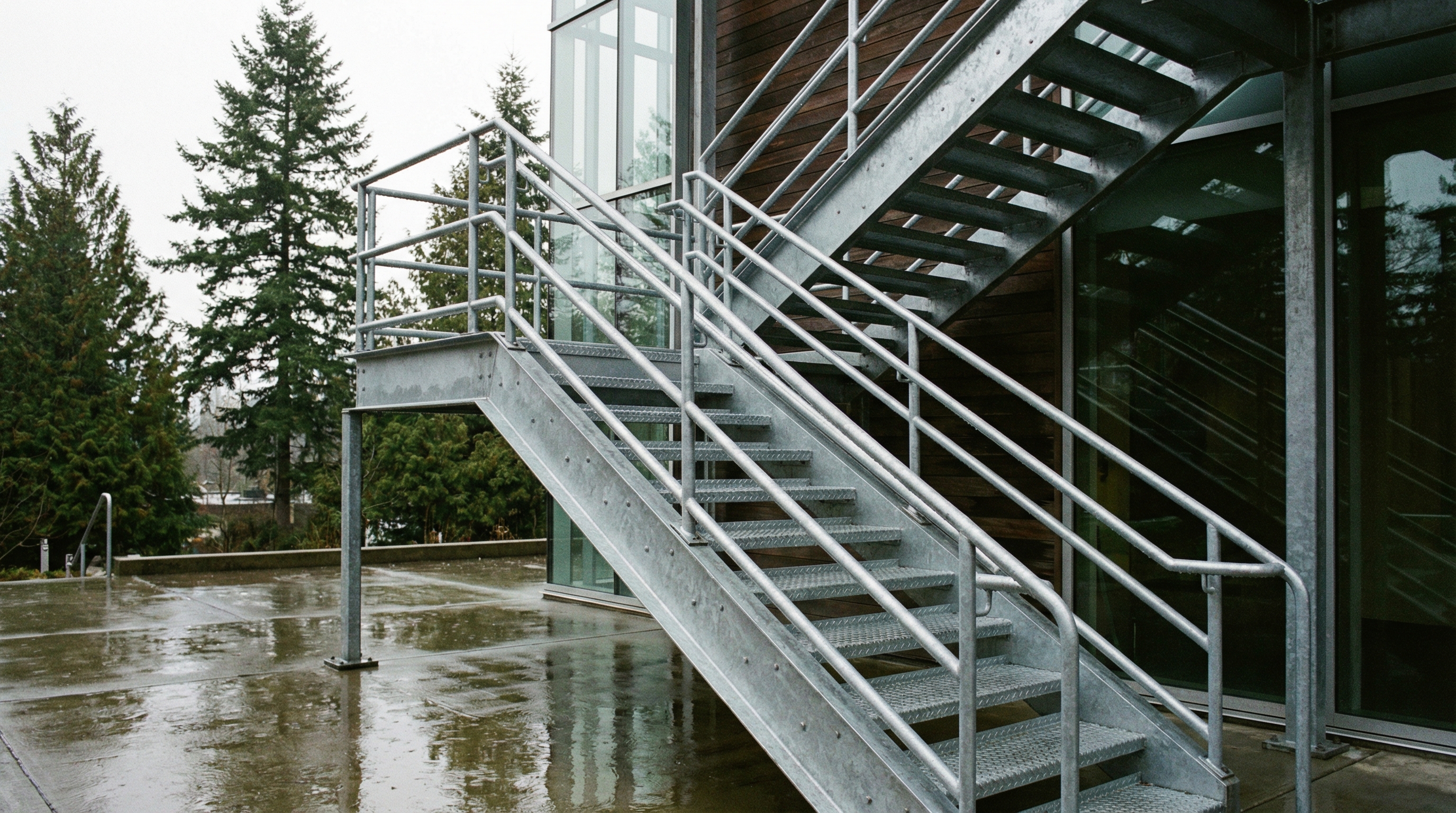
Exterior steel stairs in Metro Vancouver have to survive 1500+ mm of annual rainfall, freeze-thaw cycles, salt air on coastal sites, and constant moisture. Bare steel rusts. Painted steel needs constant maintenance. Hot-dip galvanizing to ASTM A123 is the right answer — it gives you a 50+ year service life with no coating maintenance, and it's what we specify for almost every exterior stair we build.
Why galvanizing wins in this climate
Hot-dip galvanizing creates a metallurgical bond between the steel and a layer of zinc. The zinc protects the steel two ways: it physically blocks moisture and oxygen from reaching the steel surface, and it acts as a sacrificial anode — the zinc corrodes preferentially, so even if the coating is scratched or damaged, the surrounding zinc protects the exposed steel.
In the Vancouver climate (rated as "moderate corrosivity" under ISO 9223 — somewhere between C2 and C3), an ASTM A123 galvanized coating is rated for 50–100 years to first maintenance. That is the kind of service life that lets a school district or property manager spec a stair and walk away from it for the life of the building.
Common applications we build
- Deck and second-storey access stairs: Residential decks where the stair runs from grade to a second-floor deck. Usually 8–14 treads, simple straight run, sometimes with an intermediate landing.
- Fire escapes and emergency egress stairs: Multi-storey commercial and multi-family buildings. Often replacements for aging painted-steel egress stairs that have reached end of life.
- School and institutional exterior stairs: Schools, community centers, and institutional buildings where the stair has to handle heavy daily use and zero-maintenance ownership. We have built this kind of stair for projects across the Lower Mainland, including Maple Ridge schools.
- Mechanical and industrial access: Rooftop equipment access, mezzanine ladders and stairs, parkade stair runs.
- Waterfront and marine applications: Where chloride exposure is a concern, we sometimes pair galv with stainless 316 hardware or upgrade to a duplex coating.
Tread options for exterior use
The tread surface has to provide drainage and slip resistance. Three options handle almost every exterior stair we build:
- Checker plate (tread plate): Steel plate with a raised diamond or teardrop pattern rolled in. Provides slip resistance, sheds water reasonably well. The most common choice for residential and light commercial exterior stairs.
- Perforated steel: Plate with punched holes that allow water and snow to drain through. Strong slip resistance, good for snow climates. Common on school and institutional stairs.
- Bar grating: Open grid of steel bars. Maximum drainage, maximum grip. Used on industrial stairs, parkade access, and high-snow applications.
Design considerations specific to galvanizing
Galvanizing changes how a stair has to be designed. A few things we always check during shop drawings:
- Bath size: The galvanizing kettle has finite dimensions. Long stair flights have to either fit the kettle or be assembled in sections that get galvanized separately and bolted together on site.
- Vent and drain holes: Hollow steel sections (HSS tubes used as stringers, posts, handrails) need vent and drain holes so molten zinc can flow in and air can escape. ASTM A385 specifies the requirements. Skipping this causes explosions in the kettle and rejects the assembly.
- Distortion: The thermal cycling of dipping a fabricated assembly in 450°C zinc causes some distortion. The fabrication has to be designed and welded with that in mind — symmetric weld patterns, balanced sections, and tolerances that account for movement.
- Touch-up: Any field welding or post-galvanizing modification has to be touched up with a zinc-rich paint that meets ASTM A780. We supply touch-up kits with installations.
Project example — Maple Ridge school stair
One of our recurring institutional projects is exterior galvanized stair work for schools in the Lower Mainland. These are textbook galvanized stair applications: heavy daily use, zero-maintenance expectation, exposed to weather year-round, structural quality expected. We fabricate, galvanize, and install — the stairs are still in service years later with no coating maintenance.
When galvanizing is not the right answer
Hot-dip galvanizing handles almost every exterior stair application we see, but there are a few cases where something else makes more sense:
- Architectural finish is critical: If the stair has to match a specific RAL colour or the client wants a brushed metal look, galvanizing alone won\'t deliver. Duplex coating (galvanizing + powder coat) or stainless steel is the answer.
- Waterfront / heavy chloride exposure: In true marine environments with constant salt spray, galvanizing performs but stainless 316 often lasts longer and looks better over time.
- Temporary structures: For stairs with a known short service life (construction site access, event structures), the upfront cost of galvanizing isn\'t justified. Painted steel or bare steel with a sacrificial coating works.
- Aluminum is specified by the architect: Aluminum is inherently corrosion-resistant and doesn\'t need coating. It\'s more expensive than galvanized steel but the finish can be anodized to a specific colour.
Related reading
The materials guide covers galvanizing alongside other finish options in more detail. For interior stair options, see the mono stringer guide. And for what drives pricing across all stair types, see the cost guide.
FAQs about exterior galvanized stairs
Why galvanize exterior steel stairs in Vancouver?
The Pacific Northwest climate is brutal on bare or painted steel. Hot-dip galvanizing to ASTM A123 forms a metallurgical zinc bond that protects the steel for 50+ years in this environment without coating maintenance. Painted exterior steel — even with a high-quality industrial coating — needs touch-ups every 5–10 years and full recoats every 15–20. Galvanizing is the right answer for any exterior steel that has to last.
How does the galvanizing process actually work?
After fabrication and quality control, the assembly is delivered to a galvanizing facility (in our case, usually a partner facility in the Lower Mainland). The steel is cleaned in caustic and acid baths, fluxed, and then dipped in molten zinc at around 450°C. The zinc bonds metallurgically with the steel surface, forming layers of zinc-iron alloy plus a pure zinc top layer. The whole process adds about 5–7 days to fabrication lead time.
What does galvanized steel look like?
Galvanized steel has a distinctive industrial finish — visible spangle pattern, slightly textured, ranging from bright silver-grey when new to dull matte grey as it weathers. The look is honest and functional, which works for fire escapes, deck access, school stairs, and industrial applications. For projects where architectural finish matters, galvanized steel can be powder-coated over top (called "duplex coating") to combine the corrosion protection of galv with the color and texture of powder coat.
Are galvanized exterior stairs slippery in the rain?
Smooth galvanized steel can be slippery when wet — which is why we never use plain plate for exterior stair treads. Standard exterior tread options are checker plate (tread pattern molded into the plate), perforated steel (drains water and provides grip), and bar grating (fully open for water and snow drainage). All three are code-compliant and provide enough slip resistance for outdoor use in this climate.
How much do exterior galvanized stairs cost?
Exterior galvanized stair pricing depends on the number of treads, stair width, whether landings are required, railing configuration, and the overall assembly weight (which affects the galvanizing cost). School and institutional stairs with longer runs and intermediate landings cost more than a simple residential deck-access stair. Compared to painted exterior steel, galvanized is more expensive upfront but saves money over the building life because there is no recoating cycle. <a href="/request-a-quote/">Contact us for a project-specific quote</a>.
How long does the galvanizing process take?
Once the fabricated assembly is delivered to a galvanizing facility, the actual dipping process takes a few hours — cleaning, fluxing, heating, dipping, cooling, inspection. But the facility runs on a schedule and the full turnaround from drop-off to pickup is usually 5–7 business days. For time-sensitive projects we book the galvanizing slot in advance so the schedule doesn't slip.
Can you paint over galvanized steel?
Yes — this is called "duplex coating" and it combines the corrosion protection of galvanizing with the architectural finish of powder coat or wet paint. The galvanized surface has to be properly prepped (etch primer or sweep blast) before the top coat is applied. Duplex coating costs more than galvanizing alone but provides the longest service life of any coating system in the Pacific Northwest climate and is what we specify when exterior steel needs both durability and a specific colour.
What is ASTM A123 and why does it matter?
ASTM A123 is the standard that defines hot-dip galvanizing for steel products. It specifies minimum coating thickness (usually 75–100 microns for structural sections), inspection criteria, and acceptance standards. When we specify "galvanized to A123" on shop drawings, we're telling the galvanizer which quality standard to meet and giving the building inspector a reference to check against. Any reputable galvanizer in BC works to this standard.
Will galvanized steel stain nearby concrete or stucco?
Freshly galvanized steel can cause some runoff staining on surrounding light-colored surfaces during the first 6–12 months of weathering. The stain is from zinc oxide and is more cosmetic than structural. Design details that direct drainage away from light surfaces minimize the issue. For high-visibility locations we sometimes specify duplex coating specifically to avoid this.
How long will galvanized stairs last in Vancouver?
Under ISO 9223 atmospheric corrosivity categorization, most of Metro Vancouver is classified as C2 (low) to C3 (medium) — we get a lot of rain but we're not as corrosive as a true coastal marine environment. For an ASTM A123 galvanized coating in C3 conditions, the American Galvanizers Association's service life chart projects 50–75 years to first maintenance. In practice, we see galvanized stairs perform for the full design life of the building.
Can I touch up galvanizing after installation or field welding?
Yes. ASTM A780 specifies touch-up and repair procedures for galvanized coatings. The most common methods are zinc-rich paint (applied with a brush for small areas) and zinc metallizing (applied with a specialized spray gun for larger repairs). We supply touch-up kits with every galvanized installation so the GC or the homeowner can address small nicks or scratches over the life of the stair.
How is snow and ice handled on exterior galvanized stairs?
Open tread designs (bar grating, perforated plate, checker plate with drainage) handle snow well because water drains through rather than collecting on the tread. For ice, the stair surface itself does most of the work — bar grating stays grippy even when iced because the teeth of the grating sit above the ice surface. For locations with heavy snow load (higher elevations, Whistler corridor), the stair has to be designed for the combined live + snow load.
Can you fabricate an exterior stair to match an existing building facade?
Yes. We regularly produce exterior stairs that coordinate with a specific building facade through detailing — matching the picket spacing to existing architectural elements, colour-matching the handrail, using a specific tread pattern. The trade-off is that every custom detail adds fabrication time. For institutional repeat work (multiple schools, multiple buildings on a campus), we can standardize details that make sense across the project portfolio.
Get in touch
Need a fabrication quote?
Send drawings, photos, or even a rough description. We will review what you have and follow up with a quote or a conversation about next steps.