Resource hub — Metro Vancouver
Metal stair fabrication in Metro Vancouver
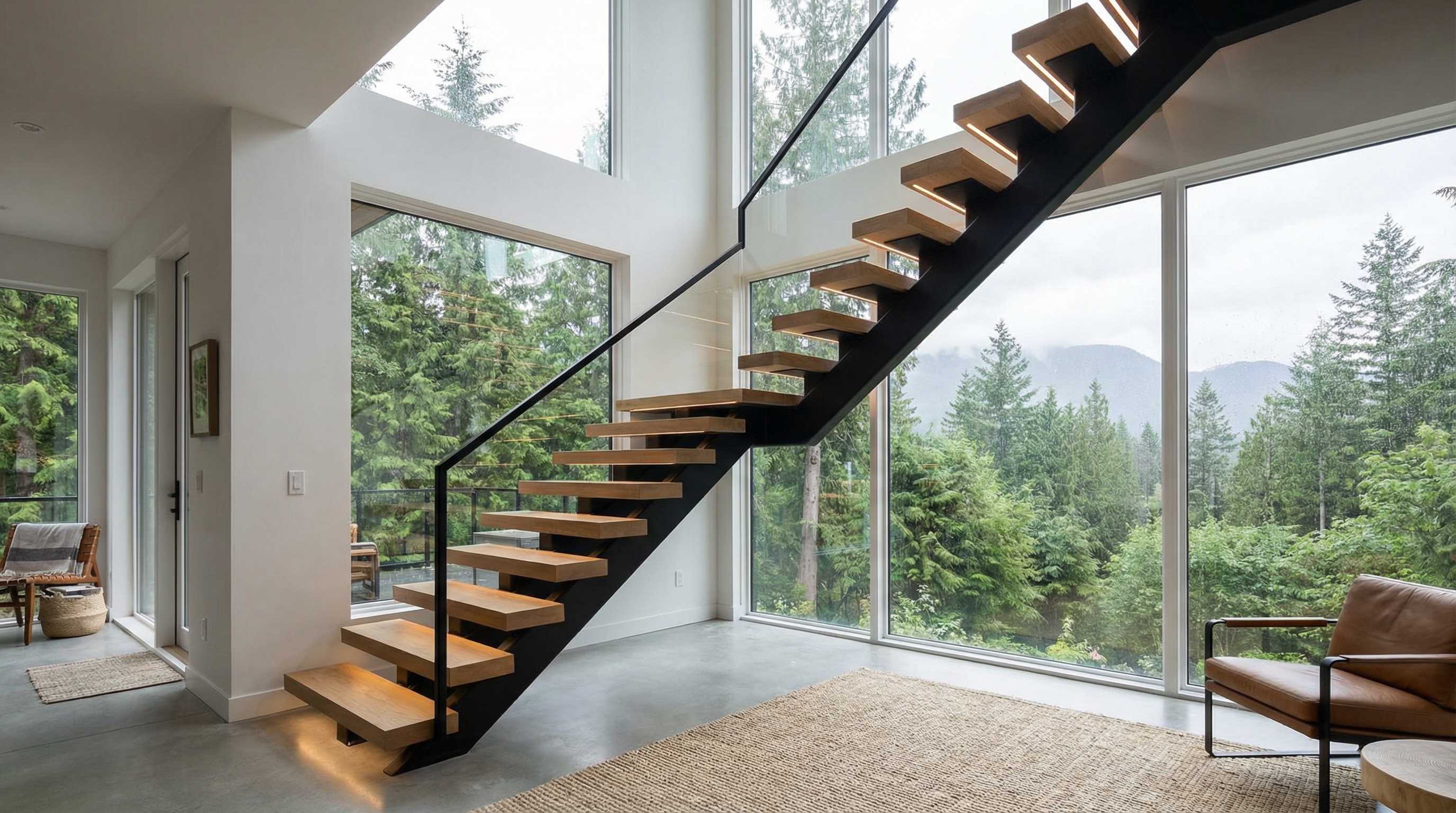
Custom metal staircases are not a catalog item. Every stair we build at Jeff and Simon starts as a sketch, an architect's drawing, or a contractor's RFI — then becomes a set of shop drawings, a fabricated and finished assembly, and an installed stair that meets the BC Building Code and the design intent. This hub covers everything that matters about that process: stair types, materials, code, cost, and the fabrication workflow from quote to installation.
Why this matters: Most stair questions come up after the framer is already on site — when there is no time to redesign. Reading this guide before you finalize the design saves real money and real schedule. If you want to skip ahead, the cost guide answers the budget question first.
Types of metal stairs we fabricate
Five broad categories cover almost every custom metal stair built in Metro Vancouver. Each has its own structural logic, finish considerations, and cost profile. The right choice depends on the architectural intent, the supporting structure, and how the stair will actually get used.
| Stair type | Best for | Typical span | Common finish |
|---|---|---|---|
| Mono stringer | Modern interior | 14–18 ft span | Powder coat |
| Floating cantilever | High-end interior | Wall-supported | Powder coat |
| Spiral | Tight footprint | 4–7 ft diameter | Powder coat or galv |
| Exterior galvanized | Decks, fire escapes, schools | Variable | Hot-dip galvanized |
| Commercial egress | Office, institutional | Multi-flight | Galv + paint or powder |
Guide
Mono Stringer Stairs
How mono stringer steel stairs are engineered, fabricated, and installed in Metro Vancouver homes. Spans, tread options, finishes, and pricing.
Guide
Floating Stairs
Cantilevered floating stair systems for high-end Vancouver residences. Engineering, wall pocket framing, finishes, lead times, and cost ranges.
Guide
Spiral Staircases
Custom spiral staircase fabrication — diameter, code requirements, interior vs exterior, materials, and pricing for Vancouver-area projects.
Guide
Exterior Galvanized Stairs
Hot-dip galvanized exterior stairs built for the Vancouver climate. ASTM A123 spec, design considerations, finish options, and project examples.
Guide
Commercial Egress Stairs
Commercial and institutional egress stair fabrication in Metro Vancouver. BC Building Code 3.4, fire ratings, handrail standards, and coordination.
Guide
Stair Cost Guide
What metal staircases actually cost in Metro Vancouver in 2026. Mono stringer, floating, spiral, and commercial stair pricing broken down by component.
BC Building Code — what every stair has to meet
Every staircase built in British Columbia has to meet the BC Building Code. For residential interior stairs, that is Section 9.8. For commercial and institutional stairs, it is Section 3.4. The specifics that come up most often on a custom fabrication job:
- Tread depth (run): Minimum 255 mm for residential interior stairs (BCBC 9.8.4.1). Commercial stairs in assembly occupancies require 280 mm minimum.
- Riser height: 125–200 mm for residential, 125–180 mm for commercial. All risers within a flight must be uniform within 5 mm.
- Stair width: Minimum 860 mm clear for residential interior. Commercial egress stairs have width tied to occupant load — generally 900 mm minimum, often 1100 mm or wider.
- Headroom: Minimum 1950 mm measured vertically from the nosing.
- Guards: Minimum 900 mm tall for stairs with a fall less than 600 mm; 1070 mm where the fall is greater. The 100 mm sphere rule applies to picket spacing.
- Handrails: Required on at least one side for stairs with more than two risers; both sides for commercial stairs and any stair wider than 1100 mm. Mounted 865–965 mm above the nosing.
On every stair we fabricate, the shop drawings explicitly call out which code sections the design satisfies. That makes the architect's review faster and the building department review predictable.
Materials — what we use and why
Material choice drives cost, lead time, finish options, and longevity. The decision is rarely just aesthetic — it shapes the whole project. A detailed breakdown lives on our materials guide, but here's how it applies specifically to stairs.
Mild steel
The default material for interior stairs in Metro Vancouver. A36 or 44W structural steel for stringers and supports, hot-rolled flat bar and tube for stair pans and railings. Mild steel takes powder coat finish well, welds cleanly, and is the most cost-effective option for most residential and commercial stairs. The trade-off is that bare steel rusts — interior applications require a finish, and exterior applications require galvanizing or a coating system.
Stainless steel (304 and 316)
Used where the look of stainless is the design intent or where corrosion resistance is critical. 304 grade for interior architectural applications — kitchens, lobbies, anywhere the finish is on display. 316 grade for waterfront and exterior applications where chloride exposure is a concern. Stainless costs roughly 3× mild steel and welding it requires specific procedures to avoid distortion and discoloration.
Aluminum
Lighter than steel, naturally corrosion-resistant, and a good fit for exterior stairs where weight matters or for projects where the architectural intent calls for an anodized aluminum finish. Trade-offs: aluminum is less stiff than steel for the same section size, welds require specific filler and procedure, and field modifications are harder.
Hot-dip galvanized steel
The right answer for most exterior stairs in this climate. Galvanizing to ASTM A123 gives a 50+ year service life on properly designed assemblies. The finish is industrial — visible spangle, slightly textured — which works for fire escapes, deck access, and school stairs but is rarely used where architectural finish matters.
The fabrication process — quote to installation
- Quote (week 0): Drawings, sketches, photos, or a site visit. We turn around budgetary pricing in 2–5 business days for most residential scopes.
- Shop drawings (weeks 1–2): Our team produces 3D shop drawings with structural details, material callouts, and installation notes. The architect, engineer, or homeowner reviews and approves.
- Material procurement (week 3): Steel, hardware, and finish materials ordered. Most structural sections are stocked locally; specialty materials add lead time.
- Fabrication (weeks 3–6): Cutting, welding, and assembly in our Burnaby shop. C.W.B. certified to CSA W47.1 throughout.
- Finishing (weeks 5–7): Powder coat, galvanizing, or paint. Galvanizing adds 5–7 days because it goes to a specialty facility.
- Installation (week 7–10): Site delivery, structural connection, and any required field welding. We handle install in-house on most residential and commercial scopes.
How to scope your stair project before you call us
The more information you bring into the first conversation, the more accurate the quote. Here's what helps:
- Total rise and run: Floor-to-floor height and horizontal distance available for the stair. Even a rough tape measurement is useful.
- Stair type preference: Mono stringer, floating, spiral, or "not sure, help us decide." We'll walk through the options.
- Supporting structure: What the stair connects to at top and bottom — concrete slab, wood floor, steel beam, etc. Photos of the surrounding space are valuable.
- Tread material: Wood (oak, walnut, fir), steel, stone, or "match the existing flooring." We'll quote against whatever you prefer.
- Railing preference: Steel picket, cable, glass, or no railing specified. Railing cost is often close to the stair structure cost, so it matters.
- Finish colour: Matte black, custom RAL, raw steel with clear coat, or galvanized. This affects cost and lead time.
- Schedule: Target installation date. This tells us whether we can fit the project into our current queue or whether we need to plan around a longer lead time.
Don't let missing information stop you from reaching out. We handle a lot of quotes from a few photos and a rough description — the full picture fills in during shop drawings.
Why Jeff and Simon for stair fabrication
Three things matter when picking a stair fabricator: certification, experience, and shop discipline. We are C.W.B. certified to CSA W47.1, which is the standard structural engineers reference on their drawings. We have built stairs for institutional clients including BCIT, Simon Fraser University, Surrey Memorial Hospital, and Guildford Town Centre, plus award-winning residential work (VRCA 2021 Award of Excellence on the Naikoon PH1 project). And we run the fabrication and installation as one workflow from our Burnaby shop, which keeps quality control tight and accountability clear.
There's also the practical side. Our shop is on Douglas Road in Burnaby, which puts us within a 30-minute drive of most project sites in Metro Vancouver. Site visits are practical, installation logistics are manageable, and scheduling a walk-through during shop drawings doesn't turn into a half-day commitment.
FAQs
What is metal stair fabrication?
Metal stair fabrication is the process of designing, engineering, cutting, welding, finishing, and installing custom staircases built from steel, stainless steel, or aluminum. A real fabrication shop handles shop drawings, structural review, cutting, welding, finishing, and installation as one integrated workflow — not as separate trades. At Jeff and Simon, every stair we build starts with shop drawings reviewed against the BC Building Code and the architect or homeowner's design intent, then moves through our C.W.B. certified shop on Douglas Road in Burnaby and out to the project site.
How much does a custom metal staircase cost in Vancouver?
Custom metal staircase pricing in Metro Vancouver depends on stair type, materials, finish, railing system, and installation complexity. Mono stringer stairs start from $18,000 for a standard configuration. Floating cantilever stairs cost more because of the engineering and embedded wall pocket framing required. Exterior galvanized stairs and commercial egress systems are each priced based on project-specific scope. The best way to get an accurate number is to <a href="/request-a-quote/">request a quote</a> with your project details — we turn around budgetary pricing in 2–5 business days.
How long does fabrication and installation take?
A standard residential metal staircase runs 6–10 weeks from approved shop drawings to installed stair. That covers material procurement, fabrication, finishing (powder coat or hot-dip galvanizing), and scheduling the install. Floating stair systems run longer — 10–14 weeks — because the wall pocket framing has to be coordinated with framers before drywall closes in. Commercial stairs run 12–18 weeks depending on engineering review cycles, finish requirements, and inspection schedules.
Do I need engineering for a metal staircase?
Yes, for any custom stair built outside of standard prefab kits. The BC Building Code requires staircases to meet specific structural, geometric, and guard requirements (Section 9.8 for residential, Section 3.4 for commercial egress). For mono stringer and floating stairs especially, a structural engineer needs to seal the design — the stringer is doing real load-carrying work and the connections to the supporting structure have to be calculated. We coordinate directly with structural engineers on every custom stair we fabricate, and we can recommend engineers we have worked with on similar projects.
What materials work best for stairs in the Vancouver climate?
For interior stairs, mild steel with a powder coat finish is the workhorse — durable, cost-effective, and visually clean. For exterior stairs, hot-dip galvanizing to ASTM A123 is the right answer in this climate because the zinc coating protects the steel for 50+ years with no recoating cycle. Stainless steel 316 is used where the look matters and the budget supports it, particularly on waterfront or premium exterior applications where salt air corrosion is a concern. Aluminum is sometimes used for lighter exterior stairs but has trade-offs on stiffness and weld appearance.
Are you certified to build structural staircases?
Yes. Jeff and Simon Ironworks is C.W.B. (Canadian Welding Bureau) certified to CSA W47.1 — the standard structural engineers reference on their drawings. That means our welders are individually qualified, our welding procedures are documented and approved, and our shop is audited annually. For any stair where the stringer carries significant load, this certification is what makes the engineer's seal possible and what building inspectors expect to see.
Do I need a building permit for a new staircase in Burnaby or Vancouver?
In most cases, yes. Both the City of Burnaby and the City of Vancouver require a building permit for new staircase construction and for structural modifications to existing stairs. A permit is almost always required when the stair is part of a means of egress, when the structural supporting elements change, or when the work is tied to a broader renovation or new construction permit. Simple replacements that don't alter the structural load path sometimes qualify for exemption, but confirm with the building department. We can prepare the shop drawings and engineering documentation the permit application requires.
Can you match an existing staircase style or replicate a design from a magazine?
Yes. We regularly work from reference photos, magazine tear-sheets, and architect's concept drawings to fabricate stairs that match a specific visual reference. The process is the same either way — we produce shop drawings that interpret the reference into a buildable, code-compliant assembly, review them with you, then fabricate. Some reference images cut corners on code or structure; we'll flag that during shop drawing review and propose solutions that maintain the look.
Who handles the flooring, drywall, and finishing trades around my stair?
We handle fabrication and installation of the stair itself. Surrounding trades — drywall closing around the stringers, flooring meeting the treads, trim, paint touch-up — are handled by the GC or by other trades. On residential projects we coordinate with the homeowner and their other trades directly. On commercial projects we coordinate through the GC's schedule. The handoffs matter and we plan them into the installation sequence.
Can metal stairs be painted a custom colour?
Yes. Most of our residential stairs are finished with powder coat in custom RAL colours. Matte black, charcoal grey, bronze, and off-white are the most common. We can match any RAL colour and we can do duplex finishes (two-tone stringers and treads, contrasting handrails) when the design calls for it. Powder coat is more durable than wet paint, more consistent in finish, and available in textured and matte variants beyond the standard gloss.
What warranty do you provide on fabricated stairs?
We stand behind our fabrication and installation. Workmanship issues discovered in the first 12 months after installation are corrected at no charge. Structural welds are certified under CSA W47.1 and documented for the life of the building. Finish issues (powder coat adhesion, paint) are typically covered by the finish supplier's warranty, which we pass through. For commercial projects we provide warranty documentation as part of the closeout package.
Do you work with homeowners directly, or only through builders?
Both. A lot of our residential work comes through custom home builders and renovation contractors, but we also work directly with homeowners — especially on one-off stair projects where the homeowner is managing their own renovation or where the stair is the main metalwork scope on the project. Either model works. The information we need is the same: drawings or dimensions, finish preference, schedule, and site access details.
What is the minimum and maximum staircase size you fabricate?
On the small end, we have built stairs as compact as a 4 ft diameter spiral for loft access. On the large end, we have fabricated commercial egress stair systems serving multi-storey buildings with multiple flights, intermediate landings, and complex geometries. Most of our residential stairs fall in the 12–18 step range (one storey of rise), and most commercial work is in multi-flight shafts. If you have an unusual size requirement, send drawings and we'll tell you whether it's in our wheelhouse.
Do you service areas outside of Metro Vancouver?
Our primary service area is Metro Vancouver and the Sea-to-Sky corridor — Burnaby, Vancouver, Coquitlam, New Westminster, North Vancouver, West Vancouver, Port Moody, Squamish, and Whistler. We have taken on select projects outside this area when the scope justifies the additional travel and logistics. Call or email with project details and we can tell you whether it makes sense.
Get in touch
Need a fabrication quote?
Send drawings, photos, or even a rough description. We will review what you have and follow up with a quote or a conversation about next steps.