Materials reference
Metal fabrication materials guide
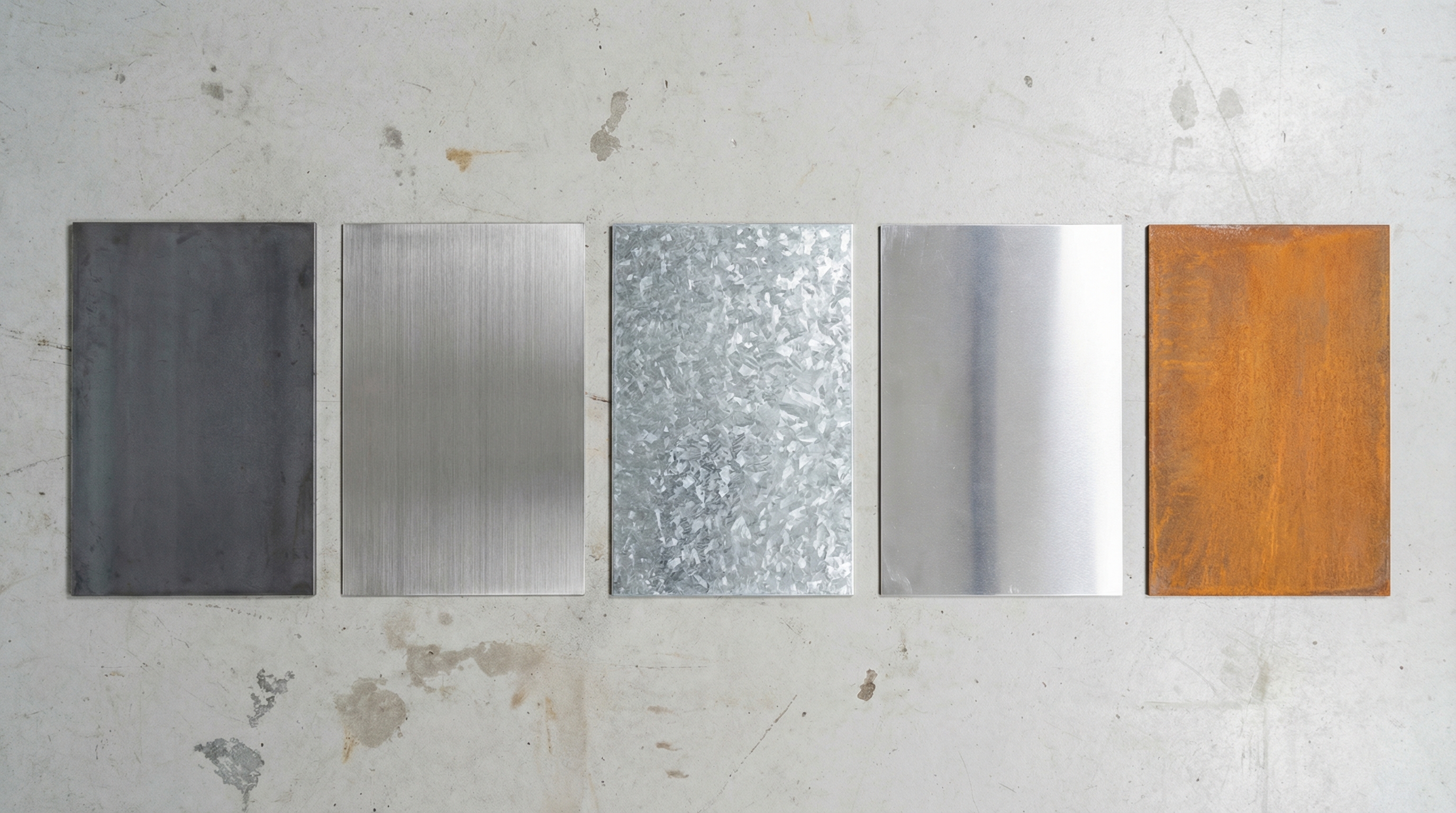
Material choice drives almost every other decision on a fabrication project: cost, lead time, finish options, weld procedures, and longevity. This page covers the materials we use most often at Jeff and Simon — what each one is good for, what each one costs relative to mild steel, and how the Pacific Northwest climate affects the choice.
Quick reference
| Material | Best for | Relative cost | Service life |
|---|---|---|---|
| Mild steel (A36 / 44W) | Interior structural, painted/powder coated | Baseline (1×) | 50+ yr indoors with finish |
| Hot-dip galvanized steel | Exterior structural, fire escapes, decks | 1.2–1.5× | 50+ yr exterior, no maintenance |
| Stainless steel 304 | Interior architectural, kitchens, lobbies | 3–4× | Indefinite, low maintenance |
| Stainless steel 316 | Coastal, marine, chloride exposure | 3.5–5× | Indefinite in coastal climate |
| Aluminum (6061-T6) | Lightweight exterior, anodized finish | 2–3× | Indefinite, no rust |
| Weathering steel (Cor-Ten) | Architectural exposed exterior | 1.3–1.6× | 50+ yr, develops patina |
Mild steel — A36 and 44W
Mild structural steel is the workhorse of custom fabrication. ASTM A36 (yield strength 250 MPa) and CSA G40.21 44W (yield strength 300 MPa) are the most common grades we use. They cover almost every structural section we work with — wide-flange beams, HSS tubes, plate, channel, angle, flat bar, round bar.
Mild steel is cost-effective, takes welding and finishing well, and is universally available. The downside is that bare steel rusts in any environment with moisture and oxygen present. For interior applications, that means a finish (paint, powder coat) is required. For exterior applications, the finish has to be more aggressive — galvanizing or industrial coating systems.
Use it for: Interior structural steel, painted/powder coated railings, indoor staircases, structural frames, beams, columns, and any application where cost matters and the finish protects the steel.
Hot-dip galvanized steel
Hot-dip galvanizing isn't a separate material — it's mild steel with a zinc coating bonded to the surface through immersion in molten zinc at around 450°C. The result is steel with a metallurgical zinc layer that protects the base material for 50+ years in this climate without coating maintenance.
Galvanizing adds roughly 20–50% to the fabrication cost depending on the assembly weight and complexity. Compared to paint or powder coat, the upfront cost is higher but the lifetime cost is lower because there is no recoating cycle. For exterior applications, galvanizing is the right answer almost every time.
Use it for: Exterior staircases, fire escapes, deck access stairs, exterior railings, structural steel exposed to weather, school and institutional exterior metalwork, parkade and below-grade structures.
Stainless steel 304
Type 304 (sometimes called 18-8 stainless) is the most common architectural stainless. It's an austenitic stainless steel with 18% chromium and 8% nickel that gives it corrosion resistance and the polished, consistent finish associated with stainless.
304 is the right choice for interior architectural applications where the look of stainless is the design intent: kitchen islands, range hoods, lobby railings, feature staircases, restaurant fitouts, and architectural metalwork in commercial interiors. It's also used for exterior applications in low-corrosion environments. The cost is roughly 3–4× mild steel, plus the welding requires specific procedures to control distortion and avoid heat-affected zone discoloration.
Use it for: Interior architectural metalwork, kitchens, restaurants, lobbies, feature staircases where stainless is part of the design, light commercial railings, food-grade applications.
Stainless steel 316
Type 316 is 304 with the addition of 2–3% molybdenum, which gives it dramatically better resistance to chloride pitting corrosion. For applications within a few kilometres of saltwater or anywhere road salt exposure is a concern, 316 is the right answer. It costs roughly 20–30% more than 304.
In Metro Vancouver, 316 is the right choice for waterfront properties (the Vancouver West Side, North and West Vancouver waterfront, oceanfront homes in West Van's coastal neighborhoods), pool and spa hardware, marine applications, and any project where chloride exposure is a real risk. Using 304 in these applications often results in tea staining and pitting within a few years.
Use it for: Coastal and waterfront applications, marine hardware, pool decks, anywhere within 5 km of saltwater, premium exterior architectural metalwork.
Aluminum (6061-T6)
6061-T6 is the most common architectural and structural aluminum alloy. It's strong (yield strength 240 MPa), naturally corrosion-resistant, and roughly 1/3 the weight of steel for the same volume.
Aluminum makes sense when weight matters (exterior canopies, retractable structures, lightweight access stairs), when the look of anodized aluminum is the design intent, or when corrosion resistance without coating is important. The trade-offs: aluminum is less stiff than steel for the same section size (so members have to be larger), welding requires AC TIG with specific fillers, and field modifications are harder.
Use it for: Lightweight exterior canopies, anodized architectural railings and screens, marine and waterfront applications where weight matters, retractable structures.
Weathering steel (Cor-Ten)
Weathering steel forms a stable rust patina on its surface that protects the underlying steel from further corrosion. The architectural intent is the patina itself — a warm, rust-colored finish that develops over the first 12–24 months and stabilizes for the life of the building.
Weathering steel works in dry climates and protected applications. In high-rainfall environments like Vancouver, the patina takes longer to stabilize and runoff can stain adjacent surfaces (concrete, stucco, stone). It can be the right choice for architectural applications where the patina is desired, but the design has to account for runoff management.
Use it for: Architectural cladding, sculptural metalwork, planter walls, feature elements where the patina is the design intent and runoff is managed.
Finish options
- Powder coat: Cured polyester or epoxy coating in any color. Standard finish for interior steel, durable, even, available in custom RAL colors.
- Hot-dip galvanizing: Metallurgical zinc bond. Industrial appearance, 50+ year service life, the right finish for exterior structural steel.
- Duplex coating: Galvanizing plus powder coat over top. Combines the corrosion protection of galv with the architectural finish of powder coat. Used where exterior steel needs both.
- Industrial paint systems: Multi-coat epoxy or polyurethane systems for specific industrial applications. Lower upfront cost than galv, requires recoating cycles.
- Brushed and polished stainless: Mechanical surface finishes on stainless steel. Brushed (#4 finish) is the most common architectural look; polished (#8 mirror) is used for premium applications.
- Anodizing: Electrochemical surface treatment for aluminum. Available in clear, bronze, black, and custom colors.
How material choice affects lead time
Material availability is a real factor in project scheduling. Here's how different materials compare for stock and lead time in Metro Vancouver:
- Mild steel structural sections: Stocked locally, typically available within 1–3 business days.
- Mild steel plate (1/4" to 1"): Standard sizes stocked, larger sizes or thicker plates may need to be ordered.
- Hot-rolled flat bar and angle: Stocked locally in standard sizes.
- Stainless 304 sheet and plate: Common sizes stocked, but less availability than carbon steel. 1–2 week lead on specialty sizes.
- Stainless 316: Less commonly stocked than 304. Usually 1–3 weeks for specialty sizes.
- Aluminum extrusions: Standard profiles are stocked; custom extrusions require a mill run and can take 4–8 weeks.
- Weathering steel (Cor-Ten): Specialty item, usually ordered per project with 2–4 week lead.
Material cost sensitivity
Steel prices are volatile. Over any given year, mild steel plate and structural sections can fluctuate 10–30% based on global markets, tariffs, and supply chain conditions. For long-running projects, we lock in material pricing at the time of fabrication commitment so schedule slippage doesn't blow the budget. For small scopes, the price on our quote reflects the market at quote time and is valid for 30–60 days.
Related reading
For CWB certified welding details, see the CWB certification page. For how materials get translated into fabricated assemblies, see the shop drawings & process page. For specific applications like stair fabrication, see the metal stair fabrication hub.
FAQs about fabrication materials
When should I use stainless steel instead of mild steel?
When the look matters and the budget supports it, or when corrosion resistance is critical. Stainless costs roughly 3–4× mild steel for the material alone, plus more for fabrication because the welding procedures and finishing are more demanding. For interior architectural work where the steel is on display (kitchens, lobbies, feature staircases), 304 stainless gives you a finish that doesn't need painting and looks consistent over time. For exterior coastal or chloride exposure, 316 stainless is the right choice.
What is the difference between 304 and 316 stainless?
Both are austenitic stainless steels with similar strength and forming characteristics. The difference is chemistry: 316 contains 2–3% molybdenum, which gives it significantly better resistance to chloride pitting corrosion. For interior work in normal environments, 304 is fine. For exterior work, especially within a few kilometres of saltwater or where road salt exposure is a concern, 316 is the right choice. The cost difference is roughly 20–30%.
Why use galvanizing instead of paint?
Hot-dip galvanizing forms a metallurgical zinc bond with the steel that protects it for 50+ years in this climate without maintenance. Paint and powder coat are coatings — they sit on top of the steel and they fail over time, especially when exposed to UV, moisture, and temperature cycling. For exterior applications, galvanizing is the right answer almost every time. The exception is when the architectural intent requires a specific paint color, in which case duplex coating (galvanizing plus powder coat over top) gives you both.
Can you mix materials in a single assembly?
Yes, with care. Mixing carbon steel and stainless requires attention to galvanic corrosion — the two metals form a galvanic couple in the presence of moisture, and the carbon steel will corrode preferentially. Solutions include isolation washers and gaskets, careful drainage detailing, and matching the materials at critical joints. Mixing aluminum with steel has similar concerns. We design around galvanic compatibility on every mixed-material assembly.
How do I know what material to specify?
For structural work, the engineer specifies based on load requirements. For architectural work, the architect specifies based on finish and aesthetic intent. For everything else, the right choice depends on three factors: where it lives (interior vs exterior, coastal vs inland), how it has to look (industrial vs architectural vs hidden), and budget. We can recommend the right material for any project — call or send the project details and we'll work through the options.
What grade of mild steel do you use for structural work?
For most structural work we use ASTM A36 (yield 250 MPa) and CSA G40.21 44W (yield 300 MPa). These grades are available in all the structural shapes (HSS tube, wide-flange, channel, angle, plate) and they weld readily with the procedures we use. For higher-strength applications, CSA G40.21 50W (yield 350 MPa) is an option but it's less commonly specified.
Why is stainless so much more expensive than mild steel?
Three reasons. First, the alloy content — stainless contains significant percentages of chromium and nickel, which are expensive commodities. Second, stainless is harder to fabricate — welding procedures are more demanding, cutting is slower, and the mechanical finishes take more labour. Third, material availability — stainless is stocked in fewer sizes, so custom orders often mean longer lead times and higher distributor markups.
Can you weld stainless to carbon steel?
Yes, with the right filler and procedure. Welding stainless to carbon steel requires a specific filler metal (typically 309 or 309L stainless) that can accommodate the metallurgical differences between the two. The weld itself is usually fine; the bigger concern is galvanic corrosion at the interface in the presence of moisture, which can be managed with isolation details or coatings.
What is the difference between hot-rolled and cold-rolled steel?
Hot-rolled steel is formed at high temperature and has a slightly rougher surface finish and slightly less precise dimensional tolerances. Cold-rolled steel is formed at room temperature after hot-rolling and has a smoother surface and tighter tolerances. For most structural fabrication we use hot-rolled. For architectural and finish-critical work, we sometimes use cold-rolled or hot-rolled pickled-and-oiled (HRPO) which has a cleaner surface.
What gauge is "too thin" for structural work?
Depends on the application. For structural stringers on a staircase, we typically use 1/4 inch (6 mm) plate as a minimum, and 3/8 inch (10 mm) or heavier for longer spans. For cosmetic cladding and non-structural railings, 11 gauge (3 mm) or 14 gauge (2 mm) is common. The structural engineer specifies the minimum thickness based on load and deflection requirements.
Can you use reclaimed or recycled steel for a project?
Sometimes. Reclaimed structural steel (I-beams, columns from demolition projects) can be re-used if the original material certifications are available and the condition is good. Recycled content in new steel is already standard — most North American structural steel contains 90%+ recycled content from the EAF (electric arc furnace) process. For projects with specific embodied carbon or LEED requirements, we can source mill test reports that document recycled content.
How do I choose between steel and aluminum for an exterior project?
Three main considerations: weight (aluminum is 1/3 the weight of steel for the same volume), corrosion (aluminum is naturally corrosion-resistant, steel needs galvanizing or coating), and cost (aluminum is 2–3× steel for the same section). For a lightweight canopy or railing where weight matters, aluminum wins. For a heavy structural element, steel wins because it's stiffer. For everyday exterior metalwork, galvanized steel is usually the best overall answer.
What about brass and copper?
We occasionally work with brass and copper for architectural accents (custom hardware, decorative panels, small feature elements). They require specific welding or brazing procedures and are too soft for most structural applications. For projects where brass or copper is the design intent, we can handle small quantities; for large scopes, a specialty metal fabricator may be a better fit.
Get in touch
Need a fabrication quote?
Send drawings, photos, or even a rough description. We will review what you have and follow up with a quote or a conversation about next steps.